


Turntable vs Rotary Arm Stretch Wrapper | DNC Automation
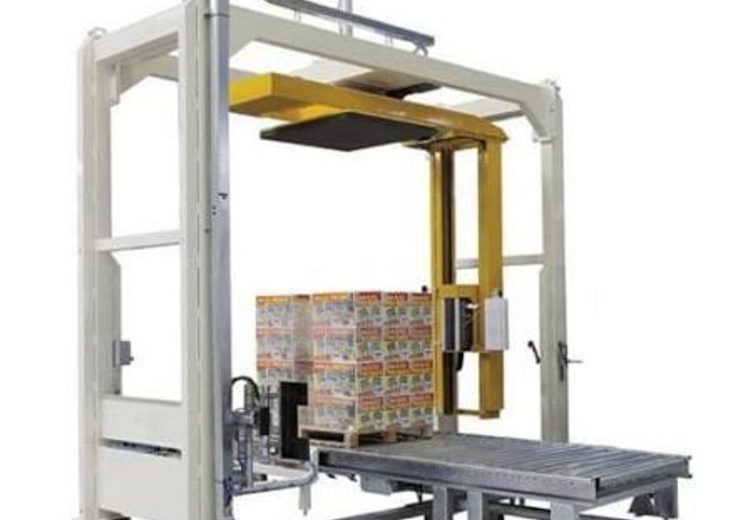
A turntable stretch wrapper and a rotary arm stretch wrapper apply film the same way – a bottom-up spiral from a pre-stretch carriage travelling a vertical mast. One thing separates them: on a turntable the pallet rotates and the carriage stays put, and on a rotary arm the pallet stands still while the arm sweeps around it. That single reference frame decides whether centrifugal force acts on your product, how much ceiling clearance the installation needs, and how easily the machine sits inside a conveyor line. Load stability settles the rotation question. Line rate settles a separate question – semi-automatic or automatic – and confusing the two is why published throughput figures for these machines contradict each other. Malaysian manufacturers specifying an end-of-line wrapper are choosing a reference frame first and a machine speed second.
What Separates a Turntable Stretch Wrapper From a Rotary Arm Stretch Wrapper
A turntable stretch wrapper differs from a rotary arm stretch wrapper, mechanically, in which body rotates during the wrap cycle. Both machines dispense film through a powered pre-stretch carriage, both travel that carriage up and down a mast, and both build containment through overlapping passes from the pallet base to the load top. Neither applies film in a way the other cannot.
The equivalence has a direct consequence for specification. Film tension comes from the pre-stretch carriage and load securement comes from the number and placement of passes, and both architectures carry both. A buyer comparing them is therefore not comparing wrap quality. The comparison is about what happens to the product while the film goes on.
How a Turntable Stretch Wrapper Runs Its Cycle
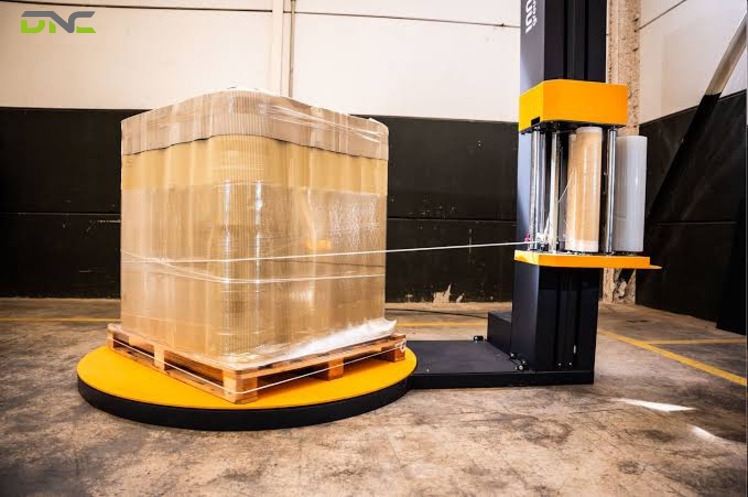
A turntable stretch wrapper puts the pallet on a powered deck and spins it. The operator or a conveyor places the load, film is attached to the pallet or clamped automatically, the deck rotates, and the carriage climbs the mast dispensing film as the load turns beneath it. Preset patterns govern tension, overlap and reinforcement passes, then the film is cut and the pallet leaves the deck.
Rotation of the load is what makes the machine compact. The mast sits at the edge of the deck and nothing moves outside the machine envelope, which is why the turntable is the most common pallet wrapping machine on warehouse and distribution floors and the usual first step into end-of-line automation.
How a Rotary Arm Stretch Wrapper Runs Its Cycle
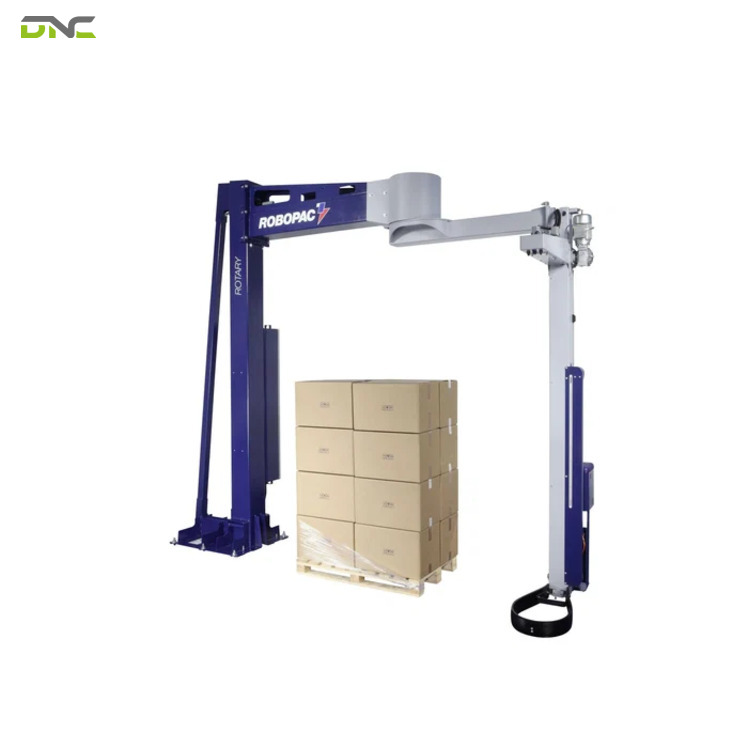
A rotary arm stretch wrapper leaves the pallet where it stands. The load is positioned in the wrap zone on the floor, on rails or on a conveyor, film is attached manually or by an automatic clamp, and a powered arm carrying the film carriage rotates around the load while the carriage travels the mast. The machine cuts and secures the film at the end of the cycle, and the pallet leaves without ever having turned.
Keeping the load still is what makes the machine large. The arm needs a swept circle it can rotate through, that circle needs guarding, and the arm hangs from an overhead structure that needs height. Everything the rotary arm gains and everything it costs traces back to one physical effect the turntable cannot avoid.
Centrifugal Force: The Mechanism Behind Every Turntable Limitation
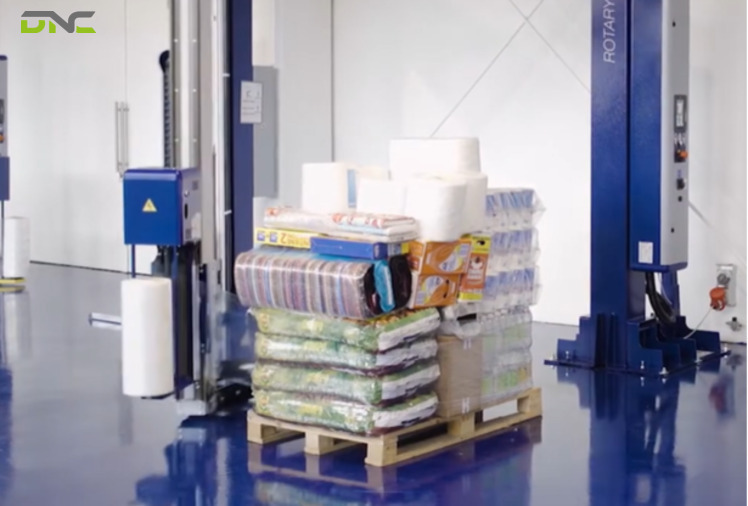
Centrifugal force is, in wrapping terms, the reason a turntable suits some loads and damages others. A rotating deck pushes product outward from the turn centre, and the effect grows with rotation speed and with how far a carton sits from that centre. A stationary load on a rotary arm experiences none of it.
Direction of the effect changes with the load, which is the part most comparisons leave out. On a stable, well-stacked pallet of uniform cases, the outward push works with the film: the spinning motion helps the wrap conform and cinch tightly against the load. On a tall pallet of beverage cases, a light stack of tissue packs, a load with a high centre of gravity or product overhanging the pallet edge, the same push shifts, leans, topples or crushes the product during the wrap cycle itself.
Irregular pallet profiles compound it at speed. An unevenly built pallet has an off-centre mass distribution, so the outward push is unequal around the turn, and the imbalance becomes more pronounced as turntable speed rises. A machine that handles the load at a slow ramp can fail the same load once it is asked to run at rate – which is the first sign that speed and stability are not one specification.
The Mechanism Behind Every Turntable Limitation
Throughput: Why Published Loads Per Hour Figures Contradict Each Other
Turntable and rotary arm throughput figures, published across suppliers, contradict each other. The loads per hour ranges below come from four independent sources crawled for this comparison, and they do not agree.
| Source type | Turntable | Rotary arm | Other architectures |
| Packaging OEM buying guide | 10–45 loads/hr | 50–90 loads/hr | Stretch hooder up to 100/hr |
| Packaging automation integrator | 30–40 semi-automatic; 80–100 automatic dual-carriage | 40–80 loads/hr | Rotary ring above 100/hr; mobile robotic 20–30/hr |
| Stretch wrapper OEM, single models | 65 loads/hr, conveyorised automatic | 95 loads/hr, conveyorised automatic | – |
| Equipment distributor | “Excellent productivity for low- to medium-volume” | “Often capable of higher throughput rates” | – |
Read the first two rows together and the problem is visible. One source caps turntables at 45 loads per hour. Another puts automatic dual-carriage turntables at 80–100 – above its own floor for rotary arms. Both are accurate. They are measuring different machines under the same two words.
The integrator publishing the widest range states the reason plainly: throughput depends on load profile, pre-stretch settings and machine-specific tuning, and the same turntable that manages 30–40 unstable light loads per hour will run 80–100 stable uniform cases. Vendor claims also vary by region and model. A loads-per-hour figure attached to nothing but an architecture label is not a specification.
Architecture and Automation Level Are Two Separate Specifications
Architecture and automation level, in a stretch wrapper quotation, are independent axes rather than one scale. Turntable and rotary arm answer the question of what rotates. Manual, semi-automatic and automatic answer the question of who delivers the pallet. Every combination exists in the market: OEM catalogues list semi-automatic turntables, automatic turntables, semi-automatic rotary arms and automatic rotary arms as four separate product families.
Automation level is defined without reference to architecture. On a manual machine the operator applies film. On a semi-automatic machine the operator brings the load in on a forklift and takes it away again, and the machine runs the cycle in between. On an automatic machine conveyors deliver the pallet, and wrapping, cutting and clamping happen without operator contact.
Most rotary arm machines are built for fully automatic operation, and that skew is what produces the illusion. A buyer comparing a semi-automatic turntable at 30 loads per hour against an automatic rotary arm at 90 attributes the gap to the arm. Most of the gap belongs to the conveyor. Fix the automation level, compare like for like, and the architectures sit far closer together than the published tables suggest – which returns the decision to where it belongs, on the load.
Load Profile: The Property That Decides Rotation Before Volume Does
Turntable or rotary arm: load profile decides the rotation question before volume has narrowed anything in most Malaysian plants. All nine sources reviewed for this comparison agree on the split, and it follows directly from the centrifugal effect described above.
| Load characteristic | Points to turntable | Points to rotary arm |
| Stack stability | Stable, uniform, consistently palletised | Loose, unstable, poorly interlocked |
| Weight | Light to medium | Very heavy pallets that would strain a rotating drive |
| Height and centre of gravity | Standard height, low centre of gravity | Tall loads, high centre of gravity |
| Product fragility | Boxed, shrink-packed, robust | Fragile, high-value, easily crushed |
| Pallet overhang | Product within the pallet footprint | Product overhanging the pallet edge |
| Packaging format | Corrugated cartons and cases | Bagged product, flexible packaging, paper reels |
Industry patterns follow the table. Distribution centres and consumer goods plants running corrugated cases stay on the turntable side because their output is uniform by definition. Food manufacturing, beverage production, industrial products and paper reel handling sit on the rotary arm side because their loads are difficult by definition.
One source in the set takes the minority position that rotary arms suit regular, uniform loads best. The other eight place regular uniform loads on the turntable and difficult loads on the arm, and the centrifugal mechanism supports the majority reading. Treat the outlier as a reminder that supplier guidance follows the supplier’s own catalogue, and check the load rather than the leaflet.
A load profile that reads as marginal is not decided by rotation alone. One machine builder in the set documents hold-down and load-lift options fitted to a rotary arm wrapper specifically to increase stability and film coverage – accessories added to a machine already chosen, quoted separately from it. No other source in the set raises the option layer at all, and a two-way architecture table has nowhere to put it. That silence matters for a marginal load: the question is not only which architecture suits it, but whether an option restores the architecture the load appeared to rule out. Put the option list in the specification next to the architecture, because a borderline load is usually settled there.
Very light product deserves separate attention because it inverts intuition. A pallet of empty containers or a light tissue stack has little mass holding it against the deck, so the outward push during rotation moves it easily. Light loads and heavy loads end up on the same side of this comparison for opposite physical reasons – and both then run into the constraint that has nothing to do with the product at all.
Load Profile: The Property That Decides Rotation Before Volume Does
Summary: What the Load Has Settled Before Any Building Constraint
Turntable and rotary arm selection is settled on three points by the load alone, all of them on the product side. The film path is common to both machines, so wrap quality is not what the comparison decides. Centrifugal force is the mechanism that splits the two architectures, and its direction reverses with load profile – helping uniform cases cinch, destabilising tall, light, fragile and overhanging product. Throughput figures published against an architecture label alone are not comparable, because automation level is a separate axis and most of the apparent speed gap belongs to the conveyor feeding the machine. What the load cannot settle is whether the building will accept the machine it points to.
Floor Space and Ceiling Clearance: The Only Hard Eliminator
Turntable floor space and rotary arm ceiling clearance are measured differently, and clearance is the only hard eliminator in the comparison. A turntable occupies its deck diameter plus the circulation an operator or forklift needs around it. A rotary arm occupies the circle its arm sweeps, plus safety guarding around that circle, plus the height its overhead structure demands.
Ceiling clearance is the one criterion in this comparison that removes an option outright. The rotary arm carries its mast and carriage on an overhead-mounted structure that must clear the tallest load the plant wraps, with the arm rotating above it. A building that cannot give that height cannot take the machine, and no load argument, volume argument or budget argument changes the answer. The advice from one integrator is direct: if footprint is the bottleneck, rule out the rotary arm first.
Guarding belongs in the same calculation. A rotating arm creates a swept volume that people must be kept out of, so fixed guarding, light curtains or a fenced cell are part of the installation rather than an accessory. A turntable has no equivalent hazard envelope, which is why guarding appears as a cost line on one side of the quotation and not the other.
The two architectures therefore fail differently in a constrained plant. A turntable installation fails on operator circulation and pallet staging space around the deck. A rotary arm installation fails on building height and cell area. Neither failure appears on a specification sheet that lists only machine dimensions – and neither shows up when the wrapper is quoted as a standalone station instead of as part of a line.
Floor Space and Ceiling Clearance: The Only Hard Eliminator
Line Integration: Why a Stationary Load Is Easier to Convey
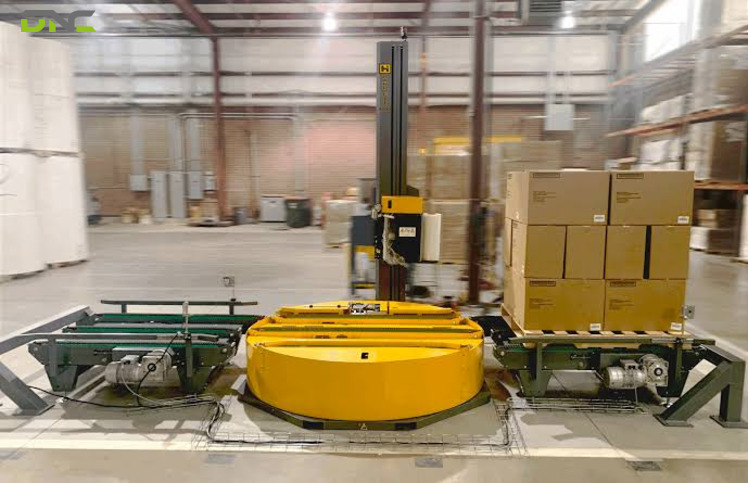
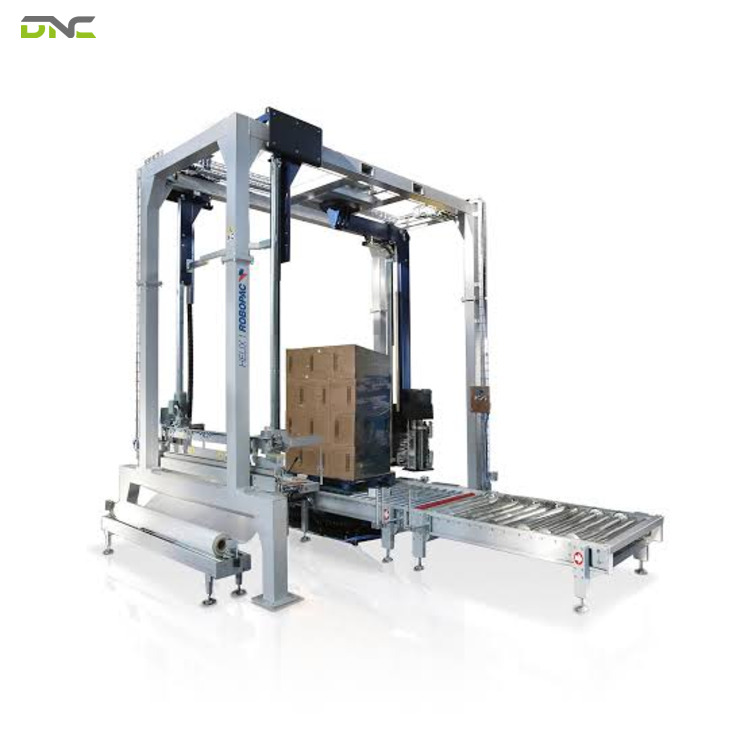
Turntable and rotary arm line integration differ by two transfers, because a stationary pallet never leaves the conveyor. Pallets travel in on a conveyor, stop in the wrap zone, get wrapped where they stand, and travel out on the same line. Suppliers describe conveyor integration as excellent on the rotary arm side and possible on the turntable side, and the distinction is mechanical rather than commercial.
A rotating load has to change surfaces. The pallet moves from the infeed onto the turntable deck, turns, and moves off the deck onto the outfeed, so every automatic turntable installation includes two transfers that a rotary arm installation does not. Automatic turntables are common and those transfers are routine engineering – they are simply two more places where an out-of-square pallet stops the line.
Full automatic operation adds the same feature set to either architecture: automatic film cut, clamp and wipe, programmable wrap patterns, load height sensing, optional top sheet or dust cover application, and supervision from the line control system. Those features are what turns a wrapping station into a line component, and a line component inherits the pace of whatever feeds it. Its cost, too, stops being the price on the machine quotation.
Cost: What Separates the Two Architectures Over the Ownership Period
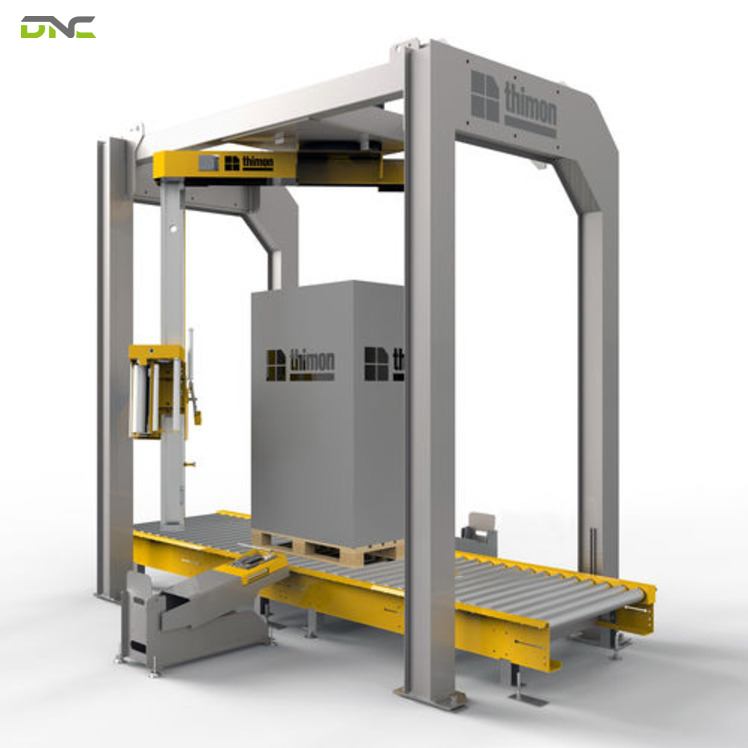
Turntable and rotary arm cost separates, over an ownership period, on installation scope rather than on the machine price alone. Capital sits higher on the rotary arm side and every source in the set agrees on that direction. Two of them publish figures, and the two agree: base-model turntables in the range of USD 60,000–65,000 and base-model rotary arms in the range of USD 70,000–80,000, placing the arm roughly 10–25% above the turntable at equivalent base specification. One is an integrator’s comparison page and the other a machine builder’s own price guidance, which makes the band a published norm rather than one vendor’s list. Those are United States base-model figures for machines alone. They exclude conveyors, guarding, installation and commissioning, and they are not a Malaysian quotation – treat them as the shape of the gap, not as a budget.
Read that pair against the width of the category and the gap shrinks into perspective. Published United States figures for stretch wrapping equipment as a whole run from around USD 2,400 at the light semi-automatic end to around USD 250,000 for high-throughput automatic installations, with hand dispensers below USD 100. The turntable-to-rotary-arm difference therefore falls inside a single band of that range: architecture moves the price by a fraction, while automation level and line integration move it by an order of magnitude. A plant treating the architecture choice as the cost decision is looking at the smaller of the two variables.
Four cost lines behind the purchase price matter more over an ownership period, and they are set out below.
- Installation scope– guarding, overhead structure, conveyor sections and commissioning attach to the rotary arm side, and none of them appear on a semi-automatic turntable quotation.
- Film consumption– the permanent cost, and it is set by pre-stretch tuning rather than by architecture. Hand-wrapped pallets consume 30–50% more film than optimised automatic systems, and properly tuned powered pre-stretch reduces film per load by 15–25% against hand wrapping or an under-set machine.
- Maintenance– more moving mass and a guarded cell mean more scheduled hours at a higher skill grade on a rotary arm, while a semi-automatic turntable is maintained close to operator level.
- Transit damage– the cost that never appears on any quotation. Roughly half of in-transit damage is attributed to ineffective wrapping in published industry estimates, with figures in the billions of US dollars annually across consumer packaged goods.
Cost per wrapped pallet, not machine price, is the comparable unit. A correctly specified powered pre-stretch turntable outperforms a poorly specified rotary arm, and an unstable load that collapses regularly on a turntable justifies a rotary arm almost immediately. Both outcomes turn on how the film is applied rather than on which body rotates.
What Separates the Two Architectures Over the Ownership Period
Film Specification: The Settings Neither Architecture Owns
Turntable and rotary arm machines share one film specification, and neither architecture owns it. Three settings decide load securement on both: pre-stretch percentage, containment force and film gauge. ASTM D4649-20, the standard guide for stretch film use, frames the job of stretch wrapping as unitizing, reinforcing and palletizing a load for storage and transport – a job description that says nothing about rotation.
- Pre-stretch percentage– the degree to which film is elongated before it touches the load. Published OEM guidance puts the working band at 150–300%, with 250% commonly cited as the practical setting. Higher pre-stretch cuts film consumed per load and raises break risk at load corners where tension concentrates; lower pre-stretch is safer on delicate product and costs more film per pallet.
- Containment force– film tension multiplied by the number of passes, the total inward squeeze holding the load together. A field norm of 15–26 lb per linear inch of load perimeter, roughly 2.7 to 4.6 kg per linear cm, is widely quoted, though it is an industry norm rather than an ASTM requirement. Machines that vary containment force by height let a load be gripped harder at the base than at the top.
- Film gauge– machine-applied film optimised for pre-stretch carriages typically runs from 50 gauge (12.7 micron / 0.5 mil) to 65 gauge (16.5 micron / 0.65 mil), against 63 gauge (16 micron / 0.63 mil) to 80 gauge (20.3 micron / 0.8 mil) for hand film. Sharp corners, contamination risk and outdoor exposure move the selection.
Under-wrapping and over-wrapping are both settings failures, not architecture failures. Too few passes or too little tension leaves zones loosely bound and product shifts in transit. Excessive pre-stretch breaks film at load corners, forcing restarts and manual supplementary wrapping. Either machine, tuned to a generic default instead of to the actual load, produces the same result – which is worth holding in view before the comparison is summarised.
Summary: How the Comparison Points Stand So Far
Turntable and rotary arm comparison points stand as follows so far, and they do not all point the same way. The film path is identical; only the rotation frame differs. Centrifugal force helps stable loads and damages unstable ones, so the mechanism itself decides the load split. Published throughput figures contradict each other because architecture and automation level are two independent axes quoted as one. Load profile eliminates an option before volume matters. Ceiling clearance is the only criterion that can remove an architecture outright. Line integration favours the stationary load by two fewer transfers. Cost separates on installation scope and film tuning rather than on the machine price. What none of the seven settles is what to do when the answer is neither machine.
When Neither Architecture Is the Answer: Ring, Robotic and Hooder
Turntable and rotary arm are both the wrong answer in three recurring cases, and a ring, a robotic unit or a hooder covers each of them.
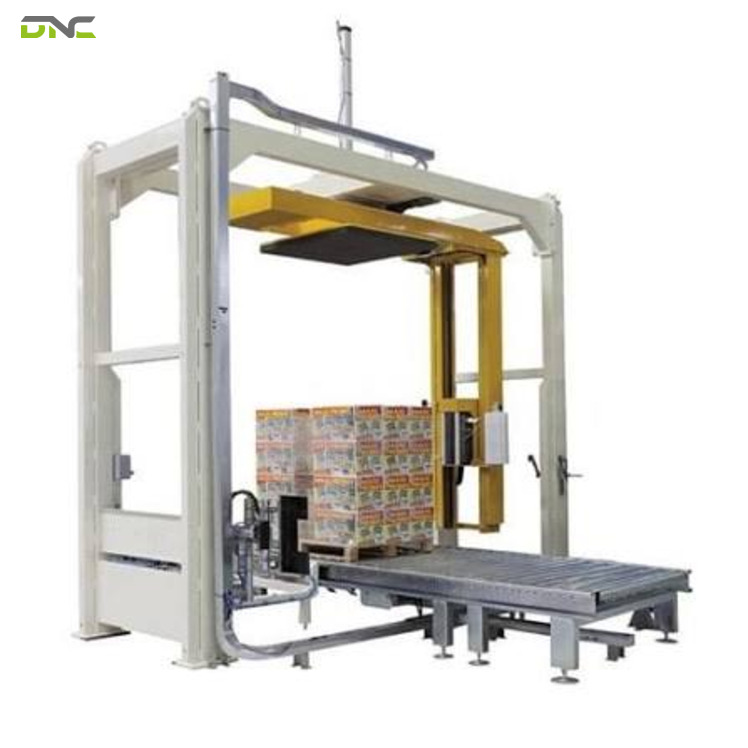
Rotary ring wrappers keep the load stationary like a rotary arm, but spin a film-carrying ring that lowers around the pallet, applies film and rises again. The rotating mass is lower than a full arm, which is why published rates exceed 100 loads per hour and close the speed gap with high-speed turntables. Rings are specified for continuous pallet flow in high-volume production, and the orbital variant of the same principle wraps flattened or awkward product – pipes, carpet rolls, doors – as a conveyor carries it through.
Robotic mobile wrappers invert the problem: instead of bringing the pallet to a machine, a free-roaming three or four-wheeled unit travels to the pallet and wraps it in place. Throughput is the trade, typically 20–30 loads per hour, in exchange for handling oversize and odd-shaped loads that exceed fixed-machine limits and for removing forklift repositioning traffic in a variable layout.
Stretch hooders apply a stretchable hood over the whole load rather than spiralling film around it. The hood seals against humidity, dust and UV exposure, and because no film is cut and wiped, the load leaves without the film tails that both wrapping architectures can produce. Hooding is a different unitizing method rather than a faster wrapper, and it earns its place where weather and contamination protection are the requirement.
Shrink hooders are a separate machine again, and the two hooders are routinely spoken of as one. A stretch hooder pulls an elastic hood down over the load and holds it by film tension alone. A shrink hooder drops a heavier hood and then contracts it with heat, which brings a burner or heat frame, a power draw and a radiant heat load into the dispatch area. The distinction matters at specification time because the two consume different films, occupy different footprints and fail differently: a stretch hood loosens, a shrink hood scorches. Where a load ships open-deck, crosses a monsoon yard or sits outdoors before collection, the genuine either/or at pallet level is a wrapper against a shrink hooder – not turntable against rotary arm.
None of these removes the original question. They set its boundary, so the two-way comparison is applied to the loads it actually governs – inside a line where the wrapper is rarely the constraint.
When Neither Architecture Is the Answer: Ring, Robotic and Hooder
Where the Wrapping Step Sits in Your End-of-Line Sequence
Turntable or rotary arm, the wrapping step sits last in the end-of-line sequence and inherits the rate of the station feeding it. Wrapping is the last mechanical operation before dispatch: it follows carton sealing, weight verification, palletizing and often strapping, and it precedes staging and loading. Its architecture only pays back when the stations around it hold the same pace and deliver pallets it can accept.
Pallet build quality is the clearest example, and it is where the rotation question is actually decided. An interlocked, square, well-distributed pallet tolerates rotation. A hand-built pallet with an uneven mass distribution and product past the edge does not, and a plant that buys a rotary arm to wrap it has bought a machine to accommodate a defect created two stations upstream. Improving the palletizing pattern sometimes returns the turntable option that the load appeared to have ruled out.
One station earlier, the sequence may not be a stretch wrapper’s at all. Stretch film secures the built pallet; shrink film secures the product or the multipack that goes onto it, which is why a line shipping palletised retail goods commonly runs both and in that order. The two are assigned by the object they hold together rather than ranked against each other, and stretch wrapping and shrink wrapping sit at different points in the same line for that reason. Settle which object needs securing before settling which rotation frame secures it.
The sequencing question runs the other way as well. A plant that has already automated palletizing with industrial robotic solutions and moves pallets on powered conveyor system solutions has usually shifted its constraint onto the wrapping step without noticing, because the wrapper is the last place where a person still touches every load. The same logic governs the neighbouring station, which is why semi-automatic and automatic strapping machines divide along a comparable line between operator-triggered and sensor-triggered cycles.
DNC’s engineers specify wrapping inside that full sequence – palletizing, conveying, weighing through automated inspection systems, strapping, wrapping, dispatch – across automotive, food and beverage, edible oils and glove manufacturing plants in Malaysia. Working from a 25,000 sqft (2323 sqm / 0.23 ha) production facility with 35 engineers under ISO 9001:2015, the practice is to fix the governing rate of the line first and the wrapper architecture second. That governing rate is what turns a general comparison into a specific recommendation.
The Stretch Wrapper Architecture That Fits Your Load and Line Rate
Turntable and rotary arm stretch wrappers are chosen, in a Malaysian manufacturing operation, against load stability first and building constraints second. The decision inputs are compared below.
| Decision input | Points to turntable | Points to rotary arm |
| Pallet stability | Interlocked, square, uniform stacks | Loose, tall, top-heavy or overhanging |
| Product weight | Light to medium loads | Very heavy pallets, or very light product |
| Ceiling height | Any usable warehouse height | Clearance above the tallest load plus arm structure |
| Floor area | Deck plus circulation space | Swept circle plus guarded cell |
| Line position | Standalone station fed by forklift | Inline, fed and cleared by conveyor |
| Throughput target | Moderate, or high with an automatic dual-carriage unit | Sustained high rate, or continuous flow |
| Capital position | Lower entry point into wrapping automation | Higher entry, justified by damage or downtime avoided |
| Damage history | Loads arrive intact today | Product shifts or collapses during wrapping now |
Two of those rows carry veto power. If the building cannot clear a rotary arm, the specification is settled regardless of every other input. If the load will not survive rotation, the specification is settled the other way, and no film setting recovers it.
Neither architecture is the upgrade of the other. A plant that installs a rotary arm to solve what is really a pallet-building problem has bought a larger machine in place of a pattern change, and the capital shows up as a guarded cell wrapping pallets a turntable would have handled. A plant that installs a turntable to save capital on loads that shift during rotation pays for it in transit damage instead, one pallet at a time.
The practical order is short. Confirm what your worst pallet looks like, not your average one. Measure the clear height above the wrap zone. Fix the automation level against the rate of the station upstream. Then read throughput figures – and only then compare quotations, with pre-stretch and containment force written into the specification rather than left to commissioning.
The Stretch Wrapper Architecture That Fits Your Load and Line Rate
Frequently Asked Questions
Turntable and rotary arm enquiries raise the questions below, asked most frequently in roughly this order. Each answer holds the two axes apart: load stability settles which body rotates, and line rate settles how much of the cycle runs without an operator.
What is the main difference between a turntable and a rotary arm stretch wrapper?
The main difference is that a turntable rotates the pallet while a rotary arm rotates the film carriage around it. A turntable keeps its film carriage fixed on the mast; a rotary arm keeps the pallet stationary and rotates the film carriage around it on an overhead arm. Every other difference in the comparison – footprint, ceiling clearance, load suitability, conveyor integration and cost – follows from that one choice.
Which stretch wrapper is faster?
Neither stretch wrapper is inherently faster. Published figures place rotary arms at 50–90 loads per hour and turntables anywhere from 10–45 to 80–100, because each figure assumes a different automation level and load profile. A semi-automatic turntable is slower than an automatic rotary arm, and an automatic dual-carriage turntable is not. Compare machines at the same automation level.
Can a turntable stretch wrapper handle unstable or irregular loads?
A turntable stretch wrapper handles stable, evenly stacked loads best, and irregular or unstable loads poorly. Rotation pushes product outward from the turn centre, so unstable, tall, light or overhanging loads can shift, lean or topple during the cycle, and irregular pallet profiles become harder to manage as turntable speed rises. Loads with those characteristics belong on a rotary arm or a rotary ring.
Which stretch wrapper suits a facility with limited space?
The turntable is the stretch wrapper that suits a facility with limited space. It needs its deck diameter plus circulation space, with no swept volume outside the machine. A rotary arm needs the circle its arm rotates through, safety guarding around that circle, and ceiling clearance for the overhead structure. Where floor area or building height is the bottleneck, the rotary arm is the option to rule out first.
Do I need a rotary arm wrapper to integrate with a conveyor line?
No, but a rotary arm wrapper does integrate with a conveyor line more simply. Because the load never moves, a conveyor can run straight through the wrap zone. An automatic turntable needs the pallet transferred onto the deck and off again, which is routine engineering and two additional points where an out-of-square pallet can stop the line.
How much more does a rotary arm stretch wrapper cost than a turntable?
A rotary arm stretch wrapper costs more than a turntable, and one published United States comparison puts the gap at roughly 10–25% at base-machine level: turntables in the USD 60,000–65,000 range against rotary arms in the USD 70,000–80,000 range. Those figures exclude conveyors, guarding, installation and commissioning, which fall mainly on the rotary arm side, and they are not a Malaysian quotation.
What is containment force, and does it differ between the two machines?
Containment force is film tension multiplied by the number of wrapping passes, and it does not differ between the two machines. It is the total inward pressure holding the load together, commonly held at a field norm of 15–26 lb per linear inch of load perimeter. It is a setting, not an architecture property, so both machines can deliver it and both can be left under-set. Write it into the specification alongside pre-stretch percentage.
What is containment force, and does it differ between the two machines?
Specifying Your Stretch Wrapper With DNC Automation
Turntable or rotary arm, specifying a stretch wrapper starts with load stability, moves to building height, and ends at the rate of the station upstream. Getting all three right at once is a line question rather than a machine question.
DNC Automation engineers end-of-line packaging as a sequence – palletizing, conveying, weight verification, strapping, wrapping and dispatch – for manufacturers across automotive, food and beverage, edible oils, glove production and building products in Malaysia. Bring your worst pallet, your clear height and your line rate to our engineers, and the architecture question answers itself.
- 13 views
- 0 Comment
Recent Comments