


RSC Carton Explained: Construction, FEFCO Code and Line Fit

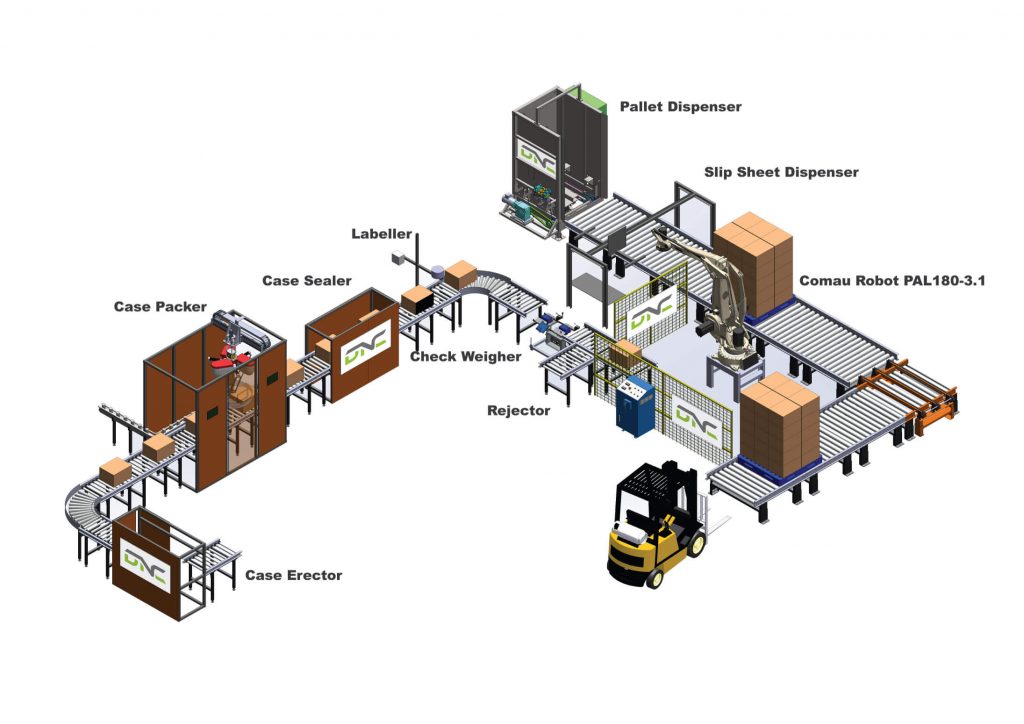
An RSC carton — Regular Slotted Container, FEFCO code 0201 — is a single sheet of corrugated fiberboard scored and slotted into four walls with equal-depth flaps on top and bottom, folded and glued at one manufacturer’s joint into a box that ships flat until it is closed. A Flexo Folder-Gluer cuts, scores, folds and glues that single blank in one continuous pass, using only straight cuts, which is why an RSC carton needs no custom die the way a die-cut box does. That same regularity — equal flaps, one joint, straight seams — is what makes the RSC carton the default input for an automated carton sealer: the machine’s folding arms and tape head are built around exactly this geometry. DNC Automation sizes carton sealing and checkweigher stations against that same carton geometry on Malaysian end-of-line packaging lines.
What Is an RSC Carton?
An RSC carton is a Regular Slotted Container — the standard corrugated box built from one sheet of fiberboard, slotted so that four connected walls fold up with four flaps on top and four flaps on the bottom, all the same depth. The two outer flaps on each side are cut to exactly half the box’s width, so when they fold in they meet at the centre with no overlap and no gap. One strip of tape along that centre seam, top and bottom, closes the box.
The design belongs to the FEFCO 02 family of slotted box styles — FEFCO being the numbering system the corrugated packaging industry uses to describe box construction — and 0201 is the code assigned to this exact flap arrangement. Because it is the box style most factories already tool up to run, an RSC carton is typically the fastest and least expensive corrugated box available in volume, which is also why it accounts for the large majority of corrugated boxes produced worldwide.
The whole box is one piece of board, joined at a single glued or stitched corner known as the manufacturer’s joint. Nothing else holds the shape together until the flaps are folded and taped. That single-joint, single-blank construction is the source of nearly every practical advantage — and every limitation — an RSC carton has against the alternatives covered further down.

What Is an RSC Carton?
How Is an RSC Carton Made?
An RSC carton is made on a Flexo Folder-Gluer, a machine that scores, slots, prints, folds and glues a flat sheet of corrugated board in one continuous pass. The process starts with a flat blank of corrugated fiberboard. The machine scores the fold lines that will become the box’s edges, cuts the slots that separate the flaps from the side walls, prints any markings the order calls for, folds the blank into its tube shape, and glues the manufacturer’s joint before the box exits flat.
Every cut in that sequence is a straight line. That is the detail that separates an RSC carton from a die-cut box at the tooling stage: a die-cut box needs a custom steel-rule die shaped to its exact outline, which adds tooling cost and lead time before the first box is even produced, while an RSC carton’s straight slots and scores run on standard Flexo Folder-Gluer tooling already set up for the general box size.
Board strength is chosen independently of that construction method. A single-wall board suits lighter goods and standard shipping; a heavier double-wall board carries more weight and resists rougher handling, which is why moving-house cartons and heavier industrial shipments are usually specified in double wall rather than single wall. Flute grade is a second, related choice — a finer flute suits lighter loads, a coarser or thicker flute suits heavier or more fragile ones — and it is set at order time, independent of the RSC style itself.
Because the box ships flat, it is set up on site only when it is actually needed for packing, which is the detail that decides how an RSC carton fits into an automated line, not just a warehouse shelf.

How Is an RSC Carton Made?
Why Is an RSC Carton the Default Input for an Automated Carton Sealer?
An RSC carton’s flap geometry — four equal-depth flaps meeting at a centre seam, one manufacturer’s joint, straight-line construction — is the geometry an automated carton sealer’s folding arms and tape head are engineered to close. A carton sealer works by folding a case’s leading flap, then the trailing flap, then the side flaps, in a fixed sequence, before a tape head runs across the centre seam as the case passes beneath it. That sequence assumes flaps of a predictable, equal depth arriving at a predictable position — which is exactly what an RSC carton’s construction guarantees and a custom or irregular flap style does not.
None of the ranked packaging suppliers researched for this article connect RSC’s flap regularity to what a folding-arm mechanism does with it — they describe the flap geometry to a box buyer choosing between package styles, not to a line engineer specifying the machine that closes the box. But the two facts sit on either side of the same seam: an RSC carton’s flaps are built to close identically on every unit, and an automated carton sealer’s mechanism is built to fold and tape flaps that close identically on every unit. That match is why RSC remains the box style least likely to need manual adjustment when a line moves from semi-automatic to fully automatic sealing — a die-cut box with a non-standard flap or locking tab, or a telescoping two-piece design, more often needs an operator’s hand or a machine reconfigured for that specific geometry.
Board condition still decides seal quality inside that match. A carton scored unevenly, or softened by storage humidity, folds unevenly regardless of how regular its FEFCO style is, which leaves a gap or wrinkle the tape head cannot fully close. Geometry sets what the sealer’s mechanism is built for; board condition on the day decides whether that mechanism gets a clean result. DNC’s engineers specify carton sealing machines against the actual case geometry and board condition running on a client’s line, not against a catalogue box style alone — a distinction covered in more mechanical detail in DNC’s companion case-sealer article, including why an unsquare case out of the sealer can also throw off an in-motion checkweigher reading three stations later.

Why Is an RSC Carton the Default Input for an Automated Carton Sealer?
How Do You Measure and Order an RSC Carton?
None of that geometry match to a sealer counts for anything if the carton itself was never specified correctly in the first place — which starts with how an RSC carton is measured and ordered. An RSC carton is measured and ordered by its internal dimensions, in the fixed order Length x Width x Height — height also called depth — usually in millimetres. Length is the longer side of the box opening, width is the shorter side, and height is the distance from the base to the opening. Measuring the inside matters because the thickness of the board itself is not counted; two boxes with identical external footprints can have different usable internal space if their board thickness differs.
Ordering also means choosing single wall versus double wall board and the flute grade to match the product’s weight and fragility — decisions that sit alongside the L x W x H figure, not inside it. A product that fills the carton with only a small cushioning gap all round packs and seals more predictably than one that leaves the walls unsupported or forces the flaps to bulge under overfill; both extremes reduce the stacking strength the RSC style is chosen for in the first place. Most suppliers set a minimum order quantity for a given size, so confirming the volume needed before ordering avoids a second short-notice run at a higher per-unit cost.
So Far: What Does RSC Carton Construction Mean for Line Fit?
An RSC carton is one sheet of corrugated fiberboard, scored and slotted into four equal-depth flaps top and bottom that meet at a single centre seam, joined at one manufacturer’s joint, and produced on a Flexo Folder-Gluer using straight cuts alone. That regularity is what makes it the lowest-cost, fastest corrugated box to produce, the box needing no custom die, and the default input geometry an automated carton sealer’s folding arms and tape head are built around. It is ordered by internal Length x Width x Height, with board grade — single wall or double wall, flute size — specified separately from the FEFCO 0201 style itself. What is still open is how RSC compares against FOL, HSC and die-cut when a product’s weight, fragility, or presentation needs pushes past what a standard RSC carton is built to do, and how Malaysia’s storage conditions change the answer before the carton is even folded.
What Does RSC Carton Construction Mean for Line Fit?
Which Carton Style Fits Your Line: RSC vs FOL vs HSC vs Die-Cut?
Choosing between RSC, FOL, HSC and die-cut carton styles comes down to how much top-and-bottom coverage, cost, and custom shape a product actually needs, as the comparison below sets out.
| Style | FEFCO code | Construction | Best fit | Trade-off vs RSC |
| RSC (Regular Slotted Container) | 0201 | Single blank, four equal flaps top and bottom meeting at centre, one manufacturer’s joint | General shipping, e-commerce, warehousing, palletizing | Baseline — lowest cost, least material waste |
| FOL (Full Overlap Container) | 0203 | Same base construction, outer flaps extended to fully overlap top and bottom | Heavier or fragile goods, rough handling, extra stacking strength | Uses noticeably more board for the added top/bottom coverage |
| HSC (Half Slotted Container) | 0200 | Flaps on the bottom only, open top | Retail display bins, picking trays, reusable containers with a separate lid | Needs a separate lid before it can ship closed |
| Die-cut | Various | Custom steel-rule die cuts a bespoke shape, tabs, or locking features | Retail packaging, subscription boxes, products needing a snug custom fit | Steel-rule die tooling adds cost and lead time before the first box ships |
RSC wins on cost and speed for a regular, rectangular product because its construction is the one that needs no custom tooling and wastes the least board. FOL trades that material saving for a fully overlapping flap on both faces, which is the style to reach for once product weight or shipping handling gets rough enough that RSC’s centre-meeting flaps stop being enough bottom and top coverage. HSC drops the top flaps entirely, which only makes sense when the application genuinely needs an open or lidded top rather than a fully closed shipping case. Die-cut abandons the straight-cut, no-tooling advantage altogether in exchange for a shape RSC’s slotted construction cannot produce — a fair trade when the box also has to work as retail presentation, not just transit protection.
How Should You Store RSC Cartons in Malaysia’s Climate?
Whichever style ends up on the line, that choice is wasted if the carton has already been weakened before it is even folded — and in Malaysia, that risk starts with how the stock is stored. Storing RSC cartons in Malaysia’s climate means managing humidity first: it is the storage variable that most directly erodes an RSC carton’s stacking strength before it is ever folded. Corrugated fiberboard absorbs moisture from the air during storage, and that absorbed moisture softens the board — a box folded from tired, humidity-softened stock fights at the seams and bulges under a load it would otherwise have carried without issue. The flat-pack format that makes an RSC carton fast to store and transport before use is also what exposes a large surface area of board to ambient humidity if bundles sit uncovered.
The practical response is storage discipline rather than a different box style: keep bundles flat and horizontal, off a concrete floor, in a dry area away from direct sunlight, and inside their original strapping until the stock is actually needed. Rotating stock on a first-in, first-out basis keeps older bundles from sitting through months of humidity exposure while newer deliveries wait behind them. Ordering the quantity a line will use within a reasonable production window, rather than holding a large buffer stock, keeps more of the fleet close to the condition it left the Flexo Folder-Gluer in — which matters directly for seal quality once that carton reaches an automated carton sealer downstream.

How Should You Store RSC Cartons in Malaysia’s Climate?
What Do Buyers Ask About RSC Cartons?
These frequently asked questions about RSC cartons cover the construction, code, and ordering details that come up most often once a packaging line moves from choosing a carton style to specifying it.
What does RSC stand for?
What RSC stands for is Regular Slotted Container, the FEFCO 0201 corrugated box style where all four top flaps and all four bottom flaps are the same depth, and the outer flaps meet without overlapping at the centre seam.
Is an RSC carton strong enough for courier or export shipping?
An RSC carton in the right board grade and flute handles normal courier and shipping conditions well. Board strength — single wall versus double wall, and flute grade — is chosen to match the product’s weight and fragility, independent of the RSC style itself.
What is the difference between RSC and FOL boxes?
An RSC carton’s outer flaps meet at the centre with no overlap, while an FOL (Full Overlap Container, FEFCO 0203) extends its outer flaps to fully cover the top and bottom, adding stacking strength at the cost of more board material — the style to choose for heavier or more fragile loads.
Can an RSC carton run on a fully automatic carton sealer?
Yes — an RSC carton’s equal-depth, centre-meeting flap construction is the geometry a fully automatic carton sealer’s folding arms and tape head are built to close, which is part of why RSC is the default carton style specified on automated end-of-line packaging cycles.
- 42 views
- 0 Comment
Recent Comments