


Filling Machine Guide: Fill Size Sets Speed and Accuracy
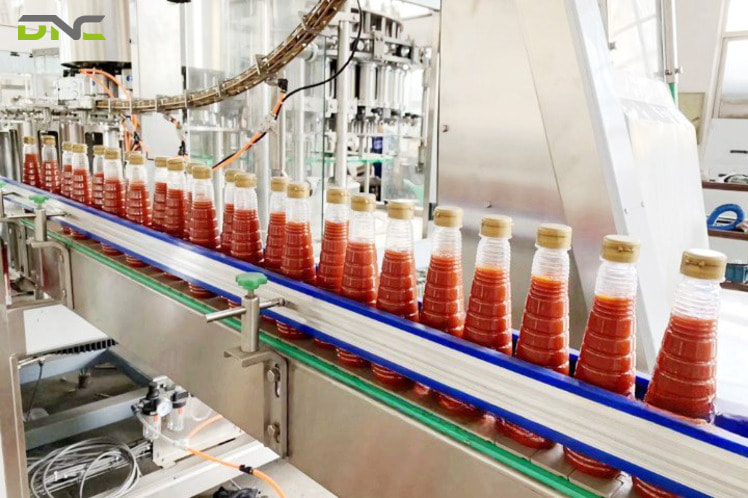
A filling machine is a metering and container-handling machine that places a set quantity of product into each container, by volume or by weight. Manual, semi-automatic and automatic machines differ by which of five cycle functions the machine owns: placing, metering, triggering, detecting and verifying. Malaysian supplier pages print speed and accuracy as single figures such as 12–30 bottles per minute or ±3 cc, yet both belong to a fill-size window. A filling machine that holds ±3 cc is a 6% machine at 50 cc and a 0.3% machine at 1,000 cc.
DNC Automation engineers specify the filling machine together with the conveyor, the capper and the checkweigher that proves the dose after the nozzle. Filling machine datasheets reduce to three automation levels, the fill-size window, three accuracy units and five paired numbers.
A Filling Machine Meters a Set Quantity of Product Into Each Container
A filling machine meters a set quantity of product into each container, and every model on the supplier pages crawled for this guide does so with the same five parts: a hopper or tank, a metering element, a nozzle, container handling and a controller. A pneumatic filler from a Malaysian reseller lists an all-stainless frame and a hopper. A semi-automatic liquid filler from another lists 316 stainless steel for the contact parts and an anti-leakage lifting filling head. A UK manufacturer describes automatic machines that integrate conveyors, multiple fill heads, sensors and control systems.
The metering element decides what the machine can promise. Metering sets the claim. A piston or pump fixes a volume, a level device fixes a fill height, and a load cell fixes a mass. Three machines can therefore carry the same name, filling machine, while measuring three different things.
A bottle filling line puts the filler between the bottle feed and the capper. DNC engineers place the filling machine inside an automated bottle filling line that runs through nine stations: bottle loading, material filling, capping, labeling, carton erecting, cartoning, carton sealing, checkweigher and robotic palletizing. The filler is station two of nine in an end-of-line packaging sequence, and it is the only one that sets the quantity every later station has to carry. Which metering element sits in that station depends first on the state of the product.
Product State Chooses the Filling Machine Family Before Any Datasheet Does
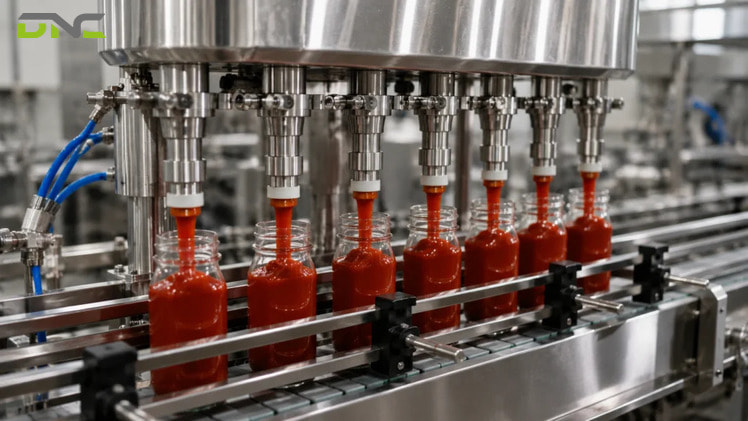
Product state chooses the filling machine family before any datasheet does, because a metering element that suits one state fails on the next. The table below sorts the families that Malaysian and UK supplier pages offer by product state.
| Product state | Metering family on supplier pages | What the pages show |
| Free-flowing liquid, oil, gel | Piston, gravity, overflow, vacuum level | An automatic linear filler for 100 mL to 5,000 mL (5 L); a vacuum-level machine “ideal for thinner liquids” |
| Paste, cream, honey | Piston or gear pump, hopper, optional heater and stirrer | A two-nozzle paste filler for 10 ml to 5,000 ml; manual paste fillers for 5 g to 50 g |
| Thick sauce, particles | Rotary piston, load-cell weigh filler on a carousel | A rotary piston filler for “thick liquid, high concentration particles”; a rotary weight filler with a load cell at each weighing station |
| Powder, granule | Auger, multihead weigher, weighing filler | A category of 25 powder and granule machines, including 25 kg and 50 kg units |
The method map for liquids, from gravity to net weight, sits in a separate guide on how a liquid filling machine works. The split between a piston that sets a dose geometrically and a pump that sets a rate has its own comparison of piston vs pump filling machine designs. This guide does not repeat either argument.
DNC’s bottle line page states that its material filling station handles liquid, powder or granules, so the family decision belongs to the line specification and not to a catalogue category. A buyer who knows the product state has narrowed the choice to one row of the table. The next narrowing is the one every supplier page advertises: how much of the cycle the machine owns.
Product State Chooses the Filling Machine Family Before Any Datasheet Does
Manual, Semi-Automatic and Automatic Filling Machines Differ by Who Closes the Fill Cycle
Manual, semi-automatic and automatic filling machines differ by who closes the fill cycle, the operator or the controller. A fill cycle has five functions: placing the container, metering the dose, triggering the start, detecting that a container is present and verifying the result. The table assigns each function to its owner at each level.
| Cycle function | Manual | Semi-automatic | Automatic |
| Place the container | Operator | Operator | Conveyor and guide rails |
| Meter the dose | Operator, by hand pressure on a piston | Machine, pneumatic piston | Machine, servo or pneumatic piston, multi-head |
| Trigger the cycle | Operator | Foot pedal or button | Container sensor and PLC (programmable logic controller) |
| Detect the container | Operator’s eye | Operator’s eye | Sensor interlock, “no bottle, no fill” |
| Verify the dose | None, or a hand check | None, or a hand check | Optional weigh station or inspection |
A manual filling machine owns one function at most, the metering geometry. A Malaysian paste filler for 5 g to 50 g with a storage tank is a typical example, and another Malaysian listing describes the class as a piston structure operated by hand pressure. Output is whatever the operator sustains, which is why one supplier’s manual collection frames the class as compact fillers for small batches of compatible liquids, creams and pastes. That supplier asks buyers to send the product, fill range, container dimensions and required temperature. A semi-automatic machine adds powered metering and a trigger: one Malaysian pneumatic range offers both continuous auto filling and a pedal mode, and a semi-automatic liquid filler publishes 5–20 and 10–40 bottles per minute.
An automatic filling machine takes the remaining functions. Its conveyor feeds containers past the heads, a sensor starts the cycle only when a container is present, and the machine fills without constant operator input, as the UK manufacturer puts it. One Malaysian automatic linear filler lists 12–30 bottles per minute, an automatic 20–200 ml model lists 30–50, and a pharmaceutical monoblock lists up to 200 units per minute.
Those ceilings overlap. A semi-automatic machine at 10–40 per minute and an automatic one at 12–30 per minute publish nearly the same band, so rate cannot name the level and the owner of the cycle can. Ownership names the level. In DNC’s engineering reading, a machine that waits for a person to place and trigger is semi-automatic whatever its nozzle count. Rate ceilings still differ inside one machine family, and the size of the dose is the variable the next table isolates.
A Filling Machine’s Speed Ceiling Falls as Its Fill Size Rises
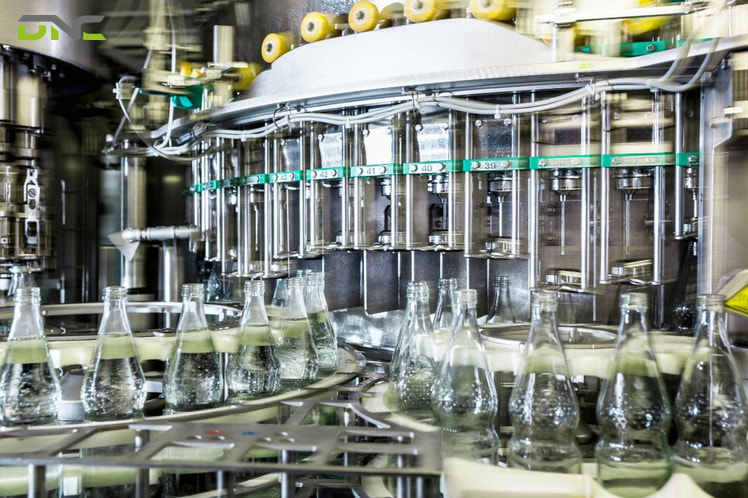
A filling machine’s speed ceiling falls as its fill size rises, and the one supplier page that prints several models side by side shows it. The UK manufacturer’s automatic piston family lists three models, shown below with the window each one is built for.
| Model | Fill-size window | Speed ceiling | Heads |
| EV1000 | 5 ml to 1,300 ml (44 fl oz) | up to 100 containers per minute | 2 to 12 |
| EV2500 | 100 ml to 2,500 ml (85 fl oz) | up to 60 containers per minute | 2 to 8 |
| EV5000 | 250 ml to 5,000 ml (169 fl oz) | up to 40 containers per minute | 2 to 6 |
The filler’s speed ceiling drops from 100 to 60 to 40 as the window top moves from 1,300 ml to 2,500 ml to 5,000 ml. The manufacturer’s own sentence names the dependency: speed depends “on the model, number of heads, fill volume, and liquid type”. No page prints a speed at a stated fill size.
The cause is mechanical. A piston stroke or a pump run takes longer as the dose grows, the stroke occupies more of the cycle, and the cycle per head caps the throughput in containers per minute. Heads multiply the cycle; they do not shorten it.
The Malaysian linear piston filler with 6 to 8 nozzles and a 100 mL to 5,000 mL window, listed at 12–30 bottles per minute, shows the arithmetic. If all nozzles fill at once, 12–30 bottles per minute across 6 to 8 nozzles works out to between 1.5 and 5 bottles per nozzle per minute, a cycle of 12 to 40 seconds. That published range sits across a window that spans a 50-fold change in dose.
Small-dose windows publish the highest ceilings on these pages. The 20–200 ml automatic model lists 30–50 per minute, and the 10–250 ml pharmaceutical monoblock lists up to 200 units per minute. A speed figure that omits its fill size therefore describes a machine at one end of its window and invites a comparison with a machine at the other. Speed is half of the window; accuracy is the other half.
A Filling Machine’s Speed Ceiling Falls as Its Fill Size Rises
Summary: Level, Family and Speed So Far
A filling machine’s level, family and speed come from three decisions fixed so far. Product state selects the metering family, from piston and pump for liquids and pastes to auger and weigher for powders. The owner of five cycle functions, operator or controller, sets the automation level, and published rate ceilings of 10–40 and 12–30 per minute show that rate alone cannot name it. Inside one family the speed ceiling falls as the fill-size window rises, from 100 to 40 containers per minute across the UK range. Accuracy statements follow the same window logic.
Filling Machine Accuracy Is Published in Three Units, So Two Datasheets Rarely Compare
Filling machine accuracy is published in three forms, absolute cc (cubic centimetres, equal to ml), relative percent and no figure, so two datasheets rarely compare. The table sets the Malaysian statements next to what each means at the edges of its own window.
| Supplier page | Accuracy statement | Unit | At the window edges (derived) |
| Pneumatic piston range, semi-automatic | ±3 cc, “depending on product and fill volume” | Absolute | 6% at 50 cc; 1% at 300 cc; 0.3% at 1,000 cc |
| Oral liquid monoblock, 10–250 ml | ±1% or better | Relative | ±0.1 ml at 10 ml; ±2.5 ml at 250 ml |
| Automatic linear piston, 100–5,000 mL | below ±0.5% to 2% | Relative band | ±0.5 to ±2 mL at 100 mL; ±25 to ±100 mL at 5,000 mL |
| Semi-automatic liquid filler | Cell left blank | None | Not stated |
| Rotary weight filler | Load cell named, no figure | None | Not stated |
The derived column is arithmetic on the printed figures, not a claim by any supplier. An absolute figure improves as the dose grows, a relative figure holds its percentage while the error in millilitres grows with the dose, and a relative band that spans a factor of four leaves the buyer a factor of four in error at every size. DNC engineers read the first question on any quotation as: at which fill size does this number hold?
None of the five statements says whether the percentage describes volume or mass. Volume is not mass. A piston delivers a volume, and mass equals volume times bulk density, so a ±1% volume figure becomes a ±1% mass figure only while the density term stays fixed. The comparison of volumetric vs gravimetric filling argues that choice in full.
For weight-based fillers, OIML R 61-1:2017, the International Organization of Legal Metrology recommendation for automatic gravimetric filling instruments, closes the gap by stating accuracy as a class X(x) tied to fill-mass bands rather than as one percentage, and none of the supplier pages crawled for these keywords cites it. The standard also gives a weighing filler a lower window edge: a minimum fill below which the class claim does not apply, 3,350 g for a 50 g scale interval at class X(1). That absence points to the other gap: what checks the dose once the nozzle has released it.
A Volumetric Filling Machine Is Verified Only After the Nozzle
A volumetric filling machine is verified only after the nozzle, because the dose it sets is a volume and nothing in the metering element reports the mass that a pack declaration usually carries. The piston, the pump and the level device each repeat a motion. None of them weighs the product.
Three supplier pages come near the subject, and each stops short. A rotary weight filler places a load cell at each weighing station and passes the signal to the PLC over a field bus. A pharmaceutical monoblock lists 100% weight inspection, tare in and tare out, as an option. The UK manufacturer’s page lists checkweighers among the equipment an automatic filler can combine with, in one clause. No page states the consequence for the buyer: a volumetric dose that drifts with density, temperature or entrained air is invisible to the machine that set it.
The verification point sits after capping, where the pack is complete and its tare is stable. A checkweigher system placed there flags any pack outside the specified weight criteria, which is the check DNC’s own bottle line page assigns to station eight of nine. At that point the weight is gross weight, so the tare spread of container, cap and label sets the floor of what the weigher can prove about net content. This is why a filling specification names the dose, the verification point and the instrument in one sentence. With that boundary drawn, the rest of the specification reads as a matching exercise, pairing each published number with the number it depends on.
A Filling Machine Quotation Pairs Five Numbers That Datasheets Print Apart
A filling machine quotation pairs five numbers that supplier datasheets print apart: speed with fill size, accuracy with fill size, accuracy with its unit, contact material with product, and the dose with its verification point. The table lists each pair and the printed example that shows why the pairing matters.
| Pair | Why it matters | Printed example |
| Speed and fill size | The ceiling falls as the dose rises | 100, 60 and 40 per minute at 1,300, 2,500 and 5,000 ml ceilings |
| Accuracy and fill size | An absolute figure is a different percentage at every size | ±3 cc is 6% at 50 cc and 0.3% at 1,000 cc |
| Accuracy and unit | Volume and mass diverge with density | “±1% or better” with no stated measurand |
| Contact material and product | The wetted parts set what the machine may fill | 316 stainless contact parts; SS 304 on a linear filler; a 316L option on a paste filler |
| Dose and verification point | Only mass proves the pack | A load cell per weighing station; optional tare in and tare out |
Utilities and compliance fill the remaining lines of a datasheet. Compressed-air supply is printed as 0.4–0.6 MPa (4–6 bar, 58–87 psi) on two Malaysian liquid fillers and as 6–8 bar (0.6–0.8 MPa, 87–116 psi) on a Turkish manufacturer’s pneumatic machines, so the plant air header becomes part of the filler specification. A pharmaceutical page adds FDA 21 CFR Part 11 and cGMP design to the list. A food or chemical plant specifies what its own audit requires and does not copy a pharmaceutical line’s compliance set.
The accuracy pair has a formal version for weight-based filling. A quotation for a weighing filler states the class and the fill-mass band. A quotation that carries only a percentage leaves the buyer to discover the band on the packing hall floor, with neighbouring machines already installed on both sides of the filler.
A Filling Machine Purchase in Malaysia Becomes a Line Decision Once the Filler Has Neighbours
A filling machine purchase in Malaysia becomes a line decision once the filler has neighbours, a conveyor upstream and a capper downstream. The supplier pages in this market list service areas from Shah Alam and Klang to Johor and Penang, and several present a standalone machine with a spec table. A standalone machine answers one question: what one station can do. The spec table does not answer how much of that throughput survives the stations on either side of it.
DNC’s engineers approach the same purchase from the line, as a turnkey integration of filler, conveyor, capper and checkweigher. The bottle line described earlier keeps the filler as one of nine stations, and the drum equivalent runs as automatic drum filling with semi-automatic and automatic systems, from automatic drum alignment to filling and palletizing. Neither is a catalogue item. Each is specified from the product state, the fill-size window and the verification point, in that order.
For Malaysian manufacturers working toward NIMP 2030, the New Industrial Master Plan 2030 unveiled on 1 September 2023 and listing enhanced Industry4WRD support among its actions, the same order protects the investment. A filler bought for its nameplate speed at the smallest dose arrives in a packing hall that runs the largest. A filler bought for a window matches the product mix the plant actually runs. The questions below cover the points Malaysian buyers raise most often.
A Filling Machine Purchase in Malaysia Becomes a Line Decision Once the Filler Has Neighbours
Frequently Asked Questions About the Filling Machine
Four questions about the filling machine come up most often with Malaysian buyers: the manual-versus-automatic split, published speed, the accuracy figure and the number of product states one machine fills. Each answer rests on the fill-size window.
What Is the Difference Between a Manual and an Automatic Filling Machine?
The difference between a manual and an automatic filling machine is who closes the fill cycle. A manual filling machine leaves placing, triggering and detecting to the operator, and a semi-automatic one powers the metering and adds a pedal or button trigger. An automatic machine takes all five functions: conveyor placement, powered metering, sensor trigger, container detection and an optional verification step.
How Fast Is an Automatic Filling Machine?
An automatic filling machine runs at published Malaysian ceilings from 12–30 bottles per minute on a 100 mL to 5,000 mL linear filler to 30–50 per minute on a 20–200 ml model and up to 200 units per minute on a 10–250 ml pharmaceutical monoblock. The UK range lists 100, 60 and 40 per minute at 1,300, 2,500 and 5,000 ml window tops. A speed figure carries meaning only beside the fill size it was printed for.
What Accuracy Figure Does a Filling Machine Datasheet Quote?
A filling machine quotation states its accuracy figure with its fill size and its unit. A volume-based filler quotes ±cc or ±% of a stated dose, and a weight-based filler quotes a class under OIML R 61-1:2017 with its fill-mass band. A percentage with neither is a brochure number. The weight-based version of that pairing is set out in the guide to the batching and dosing weighing system.
Does One Filling Machine Handle Liquid, Paste and Powder?
One filling machine does not handle all three states on a single metering element. A piston suits liquids and pastes, an auger or weigher suits powders, and the supplier pages sort their ranges by those families. DNC’s bottle line page states that its material filling station handles liquid, powder or granules, and each state gets its own matched equipment in the line. Matching equipment to state is the first field of a filling specification. Drum filling is one such matched station, covered under automatic drum filling with semi-automatic and automatic systems.
A Filling Machine Specification Starts From the Fill-Size Window
A filling machine specification starts from the fill-size window, not from the station count or the nameplate speed. The one-page version carries six fields: the product state, the smallest and largest dose, the speed at each end, the accuracy at each end with its unit, the contact material and the verification point. A supplier that cannot fill in the speed and accuracy fields at both ends of the window has sent a catalogue line, not a specification.
DNC’s engineers fix those fields first. They then size the conveyor, the capper and the checkweigher around the dose, and quote the filler last. Malaysian plants that run several product sizes on one line gain most from this order, because the window, not the nameplate, matches the product mix the line actually runs. A plant that fills three pack sizes of one product reads three windows on one machine, and a single speed figure hides two of them.
Specifying a filling machine from scratch, or checking the datasheet of one already shortlisted, starts from the same six fields. To review a supplier quotation or build a filling specification for your production line, get a free consultation with DNC’s engineering team.
- 2 views
- 0 Comment
Recent Comments