


Belt Conveyor Parts: Jobs and Wear Points | DNC Automation
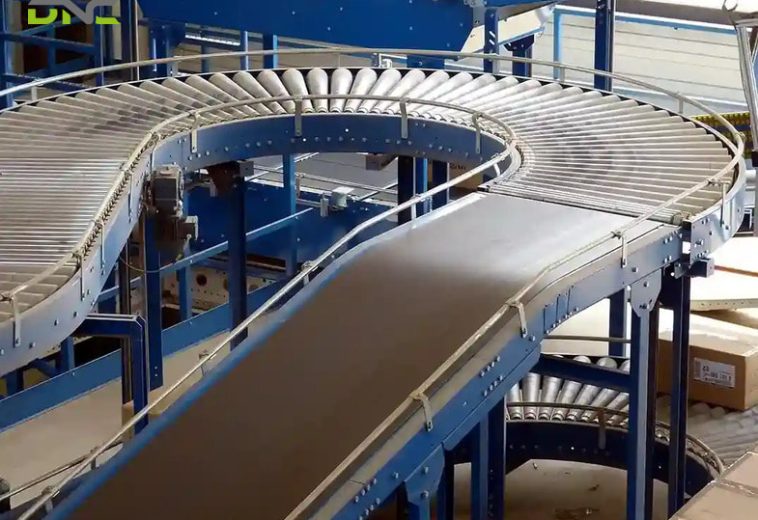
Belt conveyor parts fall into five groups: the structure that holds the line, the conveying surface that carries the load, the drive group that pulls the belt, the tension and alignment parts that keep it taut and straight, and the accessories that guard or feed it. Each part either supports the belt, pulls it or steers it. A drive pulley, a tail pulley, a take-up unit, a set of idlers and a bed under the belt do most of that work, and one worn bearing among them stops the whole belt.
Bulk lines add skirtboards and impact beds, while a packaging line in a Malaysian factory adds a bed that holds each pack steady at the checkweigher. DNC Automation recommends fixing that bed before the belt is quoted, because the belt cannot correct what the bed does to a pack.
What Are the Main Belt Conveyor Parts and What Does Each One Do?
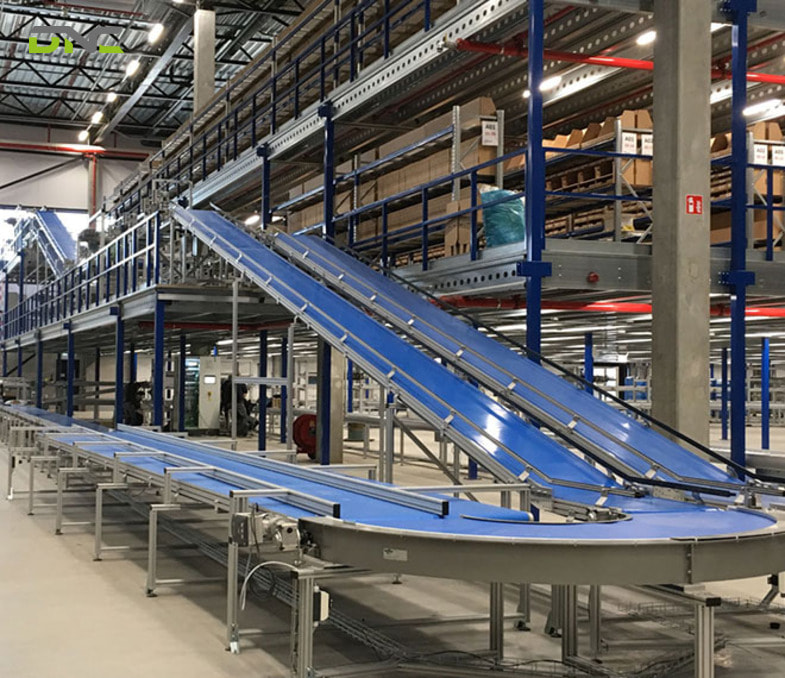
The main belt conveyor parts are the frame, the belt, the drive group, the pulleys, the idlers or bed under the belt, the take-up unit and the tracking parts, and each one supports, pulls or steers the belt. A belt conveyor is a closed loop of belting turned around two or more pulleys. The powered pulley is the drive pulley, and the unpowered one is the idler pulley.
The belt itself has three layers. The top cover meets the load, the carcass carries the pulling force and holds the belt’s shape, and the bottom cover meets the pulleys and the bed. Steel, polyester, nylon, cotton and aramid are the common carcass materials.
The table below names each belt conveyor part, places it in its group and states what it does.
| Part | Group | Job |
| Frame and support legs | Structure | Hold every other part at working height and in line |
| Guarding and emergency-stop cord | Structure | Block contact with moving parts and stop the belt from any point |
| Belt | Conveying surface | Carries the load on a continuous loop |
| Idlers or slider bed | Conveying surface | Support the belt and the load between the pulleys |
| Motor | Drive group | Turns electrical energy into rotation |
| Gear reducer | Drive group | Lowers speed and raises torque |
| Coupling | Drive group | Joins the shafts and absorbs shock |
| Drive (head) pulley | Drive group | Pulls the belt by friction at the discharge end |
| Bearings | Drive group | Let shafts, pulleys and rollers turn with little friction |
| Tail pulley | Tension and alignment | Turns the belt at the loading end |
| Snub and bend pulleys | Tension and alignment | Widen the wrap on the drive pulley and route the belt |
| Take-up unit | Tension and alignment | Removes slack and holds working tension |
| Tracking idlers and crowned pulleys | Tension and alignment | Steer the belt back to the centre |
| Chutes, skirtboards, impact beds, cleaners | Accessories | Feed, contain, cushion and clean on bulk lines |
DNC Automation designs, builds and integrates conveyors with PLC control, and a complete conveyor system automation project specifies these parts as one set, because a change in one group moves the load on the others. The drive group comes first in that chain, since it sets how hard the belt is pulled.
What Are the Main Belt Conveyor Parts and What Does Each One Do?
Which Belt Conveyor Parts Drive the Belt and Hold Its Tension?
Belt conveyor drive parts pull the belt, and the tension parts hold it taut: a motor, a gear reducer, a coupling and a drive pulley supply the pull, while a tail pulley, snub pulleys and a take-up unit hold the tension. The motor spins fast with low torque, which is the opposite of what a loaded belt needs. The gear reducer fixes that by cutting speed and raising torque. Couplings join the motor shaft to the reducer and the reducer to the drive pulley, absorbing shock and small misalignment on the way.
The drive pulley then converts torque into belt movement through friction. A rubber lagging on the shell raises that friction, and it matters most in wet or demanding environments, where a smooth shell slips. Snub pulleys add wrap angle, so more of the pulley surface grips the belt.
A take-up unit keeps that grip alive. Belts stretch with load and temperature, and a slack belt slips on the drive pulley, which wastes power and wears both surfaces. Take-up units adjust by screw or by gravity weight.
DNC Automation recommends treating the drive pulley, its lagging and the take-up as one friction system. A belt that slips points at tension, lagging or load, and replacing the pulley alone rarely cures it.
Between the two pulleys, the belt still needs something under it, and that choice is rollers or a slider bed.
Which Parts Sit Under the Belt: Rollers or a Slider Bed?
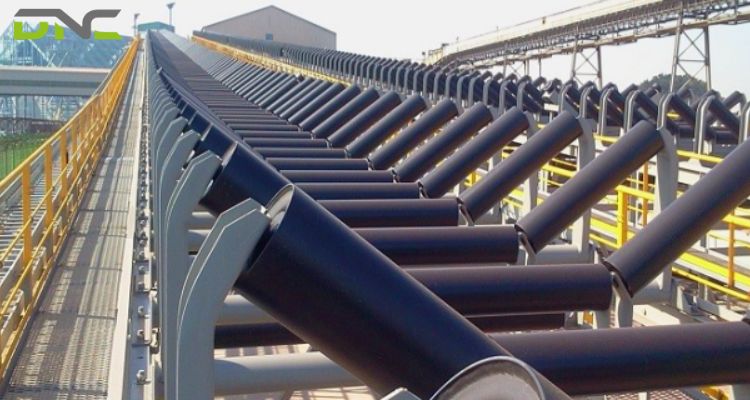
The parts under a belt conveyor’s carrying run are either rollers, called idlers, or a flat slider bed, and the choice sets friction, load capacity and how steadily a product rides. An idler is a non-driven roller that supports the belt and the load and prevents sag. A slider bed is a sheet-metal surface that the belt slides across.
Belt conveyor rollers have the most variants, so they come first.
What Are the Roller Types for a Belt Conveyor?
Rollers for a belt conveyor come as carrying, impact and return types, with lagged, tapered and guide variants for special jobs. One roller maker’s catalogue lists the working families:
- Carrying rollers support the loaded side of the belt.
- Impact rollers carry rubber rings on a steel core to absorb the shock of falling material.
- Return rollers support the empty belt, and self-cleaning versions shed material build-up.
- Lagged rollers add traction and cut wear.
- Precision rollers serve belt-scale measurement.
A tapered roller turns a curve, because its wider end travels farther per revolution. A guide roller, often rubber-coated, keeps the belt centred.
Construction matters as much as type for a belt conveyor roller. A good roller has a precision-machined tube body, bearing housings fixed at both ends by welding or deep swaging, and a self-lubricated seal that protects the bearings. Steel suits heavy loads and impact. Plastic suits corrosive duty. One plastic-roller maker lists diameters from 20 mm (0.8 in) to 100 mm (3.9 in) and lengths up to 1,500 mm (59 in), so the range is wide.
Shape changes belt conveyor roller behaviour too.
A straight roller is the general-purpose profile. A crowned roller keeps a belt or sheet centred, which is why it appears at belt ends. A grooved roller centres workpieces. A knurled roller grips, so it drives. Linings include polyurethane, silicone, nitrile, UHMWPE, chloroprene and polyacetal.
Whichever roller is chosen, the next question is whether the belt runs over rollers at all or the rollers carry the product themselves.
Is a Conveyor Belt With Rollers the Same as a Roller Conveyor?
A conveyor belt with rollers is a belt conveyor whose belt runs over a roller bed, while a roller conveyor moves the product directly on the rollers. The names blur in practice. Search phrases such as “roller conveyor belt”, “conveyor belts and rollers” and “conveyor belt and rollers” point at three different machines:
- A belt conveyor on a roller bed. The product rides on the belt, and the rollers only support it.
- A roller conveyor. The product rides on the rollers, either under gravity or powered.
- A belt-driven live roller conveyor. A belt runs under the rollers and turns them, so the belt drives the rollers and never touches the product.
The test is what touches the product’s underside. If it is a belt, the belt conveyor parts in this article apply. If it is a roller, the rollers become the conveying surface, and the product needs a rigid, flat base to bridge them.
Roller bed or slider bed is the next belt conveyor decision, and each bed has a clear territory.
How Does a Slider Bed Differ From a Roller Bed?
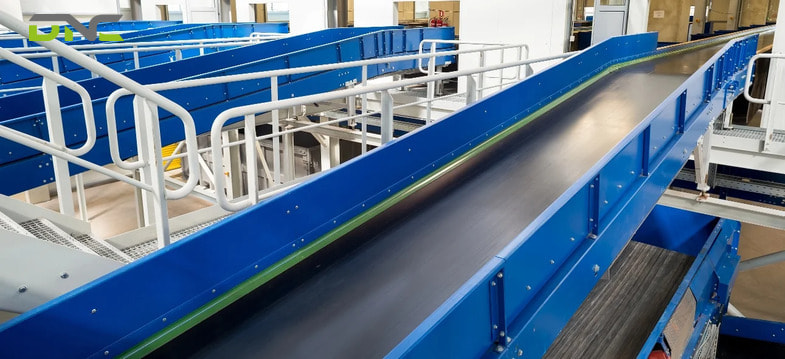
A slider bed differs from a roller bed in friction: the belt drags across sheet metal on a slider bed and rolls over bearings on a roller bed. Slider beds create more friction and need more horsepower. They also run quietly, cost least and give a stable surface, and small objects cannot fall between rollers. Roller beds cut friction and energy use, carry heavier loads, wear the belt less and need fewer drives.
Two rules from one conveyor maker’s engineering blog settle most layouts. Use a roller bed for inclines, because the climb already costs horsepower. Use a slider bed for declines, because belt friction keeps product speed controlled.
Under either bed, a belt that drifts sideways scrubs its edge against the frame, and the parts that prevent drift are the tracking parts.
How Does a Slider Bed Differ From a Roller Bed?
Which Belt Conveyor Parts Keep the Belt Tracking Straight?
Belt conveyor tracking parts are crowned pulleys, tracking or self-aligning idlers and an aligned take-up, and together they steer a drifting belt back to the centre. Mistracking means the belt walks to one side of the structure. It damages the belt edge and the frame, and a long, fast belt does it quickly.
Alignment comes before correction. Pulleys and idlers set square to the belt line are the first defence, and active tracking parts then handle the drift that remains. A crowned pulley uses its raised centre to pull the belt toward the middle. A self-aligning idler steers the belt back automatically. A grooved roller guides workpieces or the belt along a set path.
Loading matters too. Products pushed onto a belt from a side spur can shove the belt over and start a mistrack, and the same engineering blog advises putting the low-friction belt side up in that spot, against the usual rule.
A belt sway switch is the safety backstop. It stops the conveyor when the belt loses alignment.
Parts that steer the belt also scrub against it, and the parts that rub, turn under load or touch the product wear first.
Which Belt Conveyor Parts Wear Out First?
The belt cover, the bearings in idlers and pulleys, the pulley lagging, the belt cleaner blades and the skirtboard seals wear out first, because they touch the load or turn under it. The frame and the drive group often stay sound while these parts fail, so DNC Automation recommends stocking them as spares.
Each belt conveyor wear part appears in the table below with the signal that shows it is failing.
| Wear part | What fails | Signal |
| Belt cover | Cuts, frayed edges, splice damage | Exposed carcass, gouges at the loading point, edge damage |
| Idler and pulley bearings | Seizure from contamination or lost lubrication | Noise, heat, a roller that resists turning by hand, flat spots on the shell |
| Pulley lagging | Abrasion, loss of friction | Belt slip under load, smooth or missing rubber |
| Belt cleaner blades | Blade wear against the belt | Carryback on return idlers, a blade no longer under tension |
| Skirtboard seals | Wear at the belt contact line | Spillage and dust along the loading zone |
| Impact-bed bars | Compression of the cushioning layer | Belt sag at the loading point, poor skirt sealing |
Inspection sets the replacement interval, not a calendar, because load, belt speed and abrasiveness all move it. Bearing noise and belt-edge condition are the two signals that most often warn of a larger failure. A walking inspection that turns each roller by hand catches the first one early.
Not every belt conveyor wear part exists on every line, so the whole set reads best as one summary of jobs.
Summary: What Do the Parts Do to the Belt?
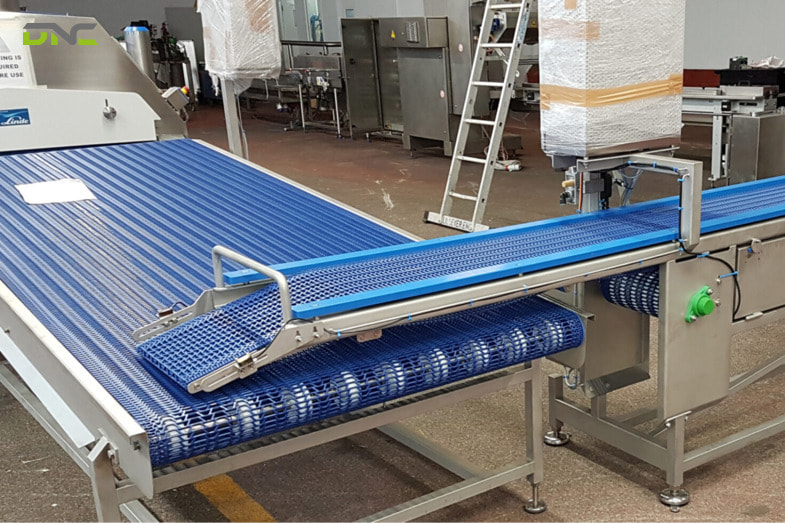
Belt conveyor parts divide by the job each does to the belt. The frame, the idlers or slider bed and the belt itself support the load. The motor, reducer, coupling and drive pulley pull it, while the take-up unit holds the tension that makes the pull work. Crowned pulleys, tracking idlers and a sway switch steer the belt and protect it. The belt cover, the bearings, the lagging, the cleaner blades and the skirtboard seals wear first, and inspection decides when each one is replaced.
Bulk and packaging belt conveyors draw on the same list but weight it differently.
What Do the Parts Do to the Belt?
Which Belt Conveyor Parts Belong on a Bulk Line and Which on a Packaging Line?
Bulk belt conveyor parts handle loose material with troughing idlers, chutes, skirtboards, impact beds and belt cleaners, while packaging belt conveyor parts handle discrete packs with a flat bed, guide rails and guarding. The published parts guidance leans toward bulk lines, so a packaging buyer needs the split spelled out.
The table below pairs the two sets by job, so a packaging buyer can see which bulk-line parts to drop, which to keep and which job each pairing serves on the belt.
| Job | Bulk line part | Packaging line part |
| Support the load | Troughing idlers shape the belt to raise capacity and stop spillage | Flat slider bed or roller bed keeps the pack level |
| Contain the load | Skirtboards seal the loading zone | Guide rails and brackets direct packs along the path |
| Take the wear | Impact-bed bars absorb falling lumps | Wear strips and liners in UHMW, HDPE or nylon take the wear |
| Keep the belt clean | Cleaners and scrapers remove carryback | Food-grade or high-temperature materials where the product requires them |
A modular light-duty belt conveyor set follows the right-hand column: clamping rails, connecting joints, guide rails, mounting brackets, support bases and tubes. One Malaysian parts supplier lists UHMW guides and wear strips, plastic idler rollers and liners, in UHMW, HDPE, nylon, acetal, polyimide and polypropylene.
The troughing idler is the clearest divide between belt conveyor lines. It exists to carry a heap, and a pack does not form one. A packaging line needs the reverse, which is a surface that keeps each pack as it was placed.
On a packaging line, the part under the belt carries one more duty: it holds each pack steady at the point where a machine reads it.
How Does the Bed Under the Belt Affect Weighing on a Packaging Line?
The bed under the belt affects weighing by setting how steadily each pack rides into the checkweigher’s weighing window: a slider bed holds the pack flat, while a roller bed lets a small or point-loaded pack bounce or turn. One conveyor maker’s engineering blog describes small, heavy round items that bounce and turn on a roller bed and settle on a slider bed, and it calls a slider bed the rule for high-speed scan tunnels. A second supplier names stable surfaces for labelling and scanning as a slider-bed strength.
Weighing raises the stakes for a belt conveyor bed. An in-motion checkweigher reads each pack in fractions of a second, and a static load cell needs several seconds to stabilise because any motion oscillates the reading. A pack that bounces during the weighing window therefore shifts the reading, which is DNC’s engineering inference from those two published figures. A bounce-induced weight error then looks like a product error, and the how a checkweigher works page explains the window that the pack must settle within.
None of the pages read for this keyword names a slider bed, and none connects a belt conveyor part to a weighing station. The parts lists describe a belt that carries a load. They never ask what the bed does to a pack in the last metre before a machine measures it.
The choice follows the pack. Regular cartons with even weight distribution suit a roller bed, which saves energy and belt wear. Small, round or point-loaded packs suit a slider bed. The bed under the checkweigher infeed deserves its own decision, separate from the bed under the rest of the line.
Once the belt conveyor bed is fixed, the remaining question is which dimensions and materials to quote when a part needs replacing.
How Does the Bed Under the Belt Affect Weighing on a Packaging Line?
What Details Does a Replacement Belt Conveyor Part Order Need?
A replacement belt conveyor part order needs the part’s dimensions, material, bearing type and operating environment, because one part name covers many sizes. Five details settle most orders:
- Diameter and length of a roller, the two dimensions one roller maker’s selection guidance asks for first.
- Shaft size, because pulleys, rollers and shafts come in many combinations of material, type and size.
- Material: steel for heavy loads, stainless or rubber-coated for wet and corrosive duty, polymer for low friction and wear.
- Bearing type: ball bearing rollers suit light to medium radial loads, and a sealed, self-lubricated bearing cuts routine maintenance.
- Environment: wash-down, high temperature, food contact or dust.
Polymer parts earn their place on guides and rails. UHMW offers a low coefficient of friction and high wear resistance, which is why a supplier lists it for chain and belt guides. Food-grade and high-temperature grades exist for the same parts, so the environment belongs on the order as much as the size does. A part ordered by name alone invites a near-fit that wears the belt or the frame. For a replacement that touches the drive group or the take-up, speak with a DNC engineer before ordering.
What Do Maintenance Teams Ask About Belt Conveyor Parts?
Maintenance teams ask four questions about belt conveyor parts more than any others. Each answer below rests on the part descriptions above, so a reader who skipped ahead still finds the part, its job and its wear signal.
What is the most important part of a belt conveyor?
The belt is usually named the most important part, because it meets the load directly and carries most of the wear. A seized bearing or a slack take-up stops the belt just as fully, so no single part is safe to ignore.
How often should conveyor rollers be replaced?
Conveyor rollers are replaced when inspection shows a fault, not on a fixed calendar. Noise, resistance to turning by hand and flat spots on the shell are the signs, and heavy-duty applications call for monthly inspection.
What are the drive parts of a belt conveyor?
The drive parts are the electric motor, the gear reducer, the coupling, the drive pulley and the bearings that support it. The motor supplies rotation, the reducer trades speed for torque, and the drive pulley turns that torque into belt movement through friction.
What materials are belt conveyor frames made from?
Belt conveyor frames are built from structural steel, usually painted carbon steel or stainless steel. Stainless steel suits food processing and corrosive areas, and painted carbon steel suits general industrial duty.
- 1 views
- 0 Comment
Recent Comments