


Choosing a Filler for Viscous Products | DNC Automation Malaysia
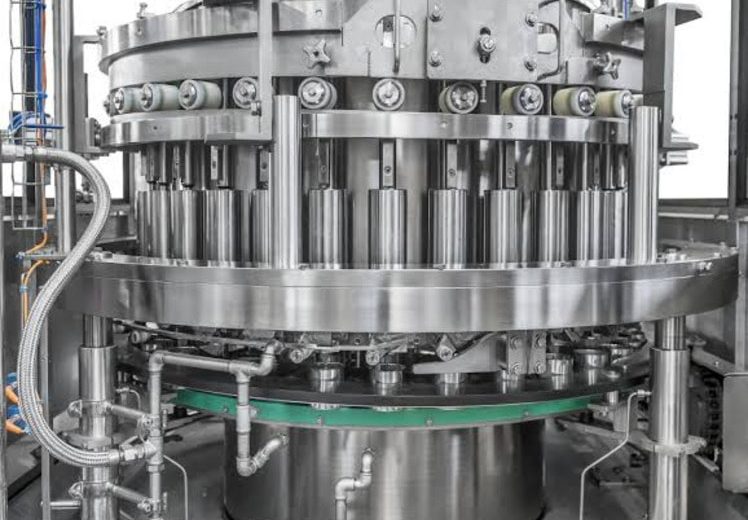
Choosing a filler for viscous products settles one question ahead of every other: which quantity the machine holds constant while the product resists flow. Four quantities are available to any filling head — elapsed time, liquid level, displaced volume and delivered mass — and above roughly 1,000 centipoise the first two drop out, leaving displacement metering and net-weight filling in contention. Piston barrels, gear pumps, peristaltic tubes and progressive cavity rotors all belong to the volume family; net-weight filling, which weighs each dose on a load cell, is the only family that measures the mass a pack normally declares. Viscosity bears on that split for a reason the market rarely states: thick product holds entrained air, air lowers bulk density, and bulk density is the term that converts a dispensed volume into a delivered weight. OIML R 61-1:2017 covers the mass-measuring family by name, liquid material included, and supplies the accuracy class, the deviation band and the minimum fill that a centipoise figure never carries.
A Viscosity Figure Is Only a Specification When It Carries a Shear Rate and a Temperature
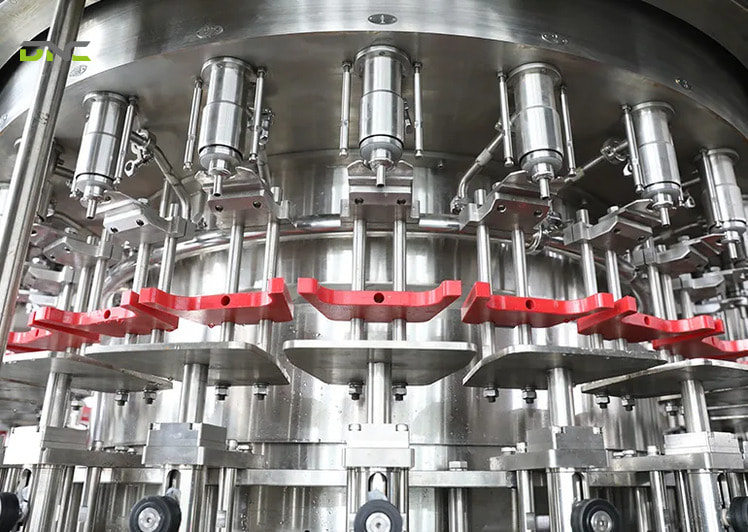
In terms of specification, a filler is selected against a viscosity figure, and that figure means something only when it names the shear rate and the temperature at which it was measured. Viscosity itself is uncontroversial across every source consulted for this article: Packserv defines it as “a liquid’s resistance to flow” with direct impact on filling speed, accuracy, machine performance and product waste, and Apex Filling Systems words it almost identically. The disagreement starts one level down, at whether a single number describes the product at all.
Four of the five machine suppliers ranking for this topic classify viscous products into three named bands and stop there. Packserv places water, alcohol-based products and essential oils in the low band; syrups, sauces, liquid soaps and detergents in the medium band; gels, pastes, honey and cosmetic products in the high band. Apex Filling Systems publishes the same three-band split with juices and dairy-based drinks added. IDA Equipment converts the bands into numbers, mapping gravity filling to 1–100 cP, overflow to 1–500 cP, pump filling to 100–50,000 cP and piston filling to 1,000–100,000+ cP.
Fuluke is the one supplier on this results page that treats the number as conditional rather than fixed. Its guidance states that non-Newtonian materials change apparent viscosity with shear rate and temperature, and that relying on time-based filling alone “risks under/over-fills when ambient conditions or batch rheology vary.” The remedy that guidance gives is a laboratory flow curve — viscosity plotted against shear rate at 15 °C, 25 °C and 35 °C — rather than a single bench reading. Entity analysis of all five pages corroborates the asymmetry: rheology, shear rate, shear thinning, apparent viscosity and non-Newtonian fluid appear in that supplier’s entity profile and in no other.
Temperature moves the figure far enough to change the machine. IDA Equipment gives a lotion measured at 25,000 cP at room temperature dropping to about 8,000 cP when heated to 45 °C, which crosses two of its own band boundaries. The same guidance warms product 2–8 °C above batch temperature specifically to cut stringing, and Jinlu Packing describes heating as the standard way to reduce pump load and raise achievable speed. A viscosity figure quoted without its measuring temperature is therefore not conservative or approximate. It is unresolved.
The table below sets out what a usable viscosity statement contains, against what a typical enquiry supplies.
| What the enquiry usually states | What the specification needs | Why the gap matters |
| “Our product is thick, around 20,000 cP” | Apparent viscosity, the shear rate it was measured at, and the temperature | Shear-thinning product reads far lower inside a pump than in a beaker |
| “It fills fine by hand” | Behaviour at production shear rates, 10–30 cpm pilot through 60–120 cpm production | Hand pouring never reaches the shear rates a filling head imposes |
| “Ambient factory temperature” | Measured range across the shift, and whether the hopper is jacketed | A 20 °C swing moves some products across a whole band |
| “Same as our last product” | Flow curve for this formulation | Two products at equal peak viscosity behave differently under shear |
For a Malaysian plant running unconditioned production space, the temperature column is the one that decides most re-quotes. The decision that follows from a resolved viscosity statement is which family of filler is still admissible.
A Viscosity Figure Is Only a Specification When It Carries a Shear Rate and a Temperature
Five Filler Families Reach Viscous Product, and They Sort by the Quantity They Hold Constant
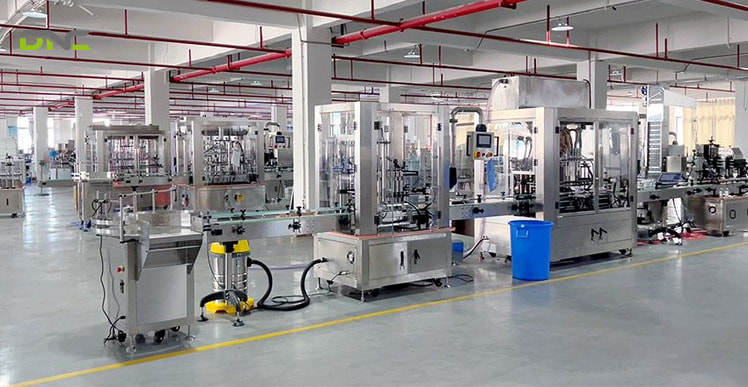
Five filler families handle product above about 1,000 centipoise, and they divide into two groups by measurand rather than into five by name. Piston, gear, peristaltic and progressive cavity heads all hold displaced volume constant. Net-weight heads hold delivered mass constant. Every operating difference the market compares between the first four — speed, changeover, particulate tolerance, shear damage — is a comparison inside one measurand, which is why an accuracy percentage taken from one group and set beside a percentage from the other misleads.
The consensus across all five suppliers is that positive displacement is the baseline once product thickens. Jinlu Packing describes the mechanism plainly: the positive displacement system “mechanically pushes a fixed volume of product forward during each filling cycle.” IDA Equipment sets the trigger at 1,000 cP or the presence of particulates. Packserv, Apex Filling Systems and Fuluke reach the same conclusion by different routes.
The table below groups the five families by the quantity each control system regulates.
| Controlled quantity | Family | Viscosity reach | Published accuracy | Free to vary |
| Displaced volume | Piston (servo or cylinder driven) | 1,000–100,000+ cP per IDA Equipment | about 0.5% of volume per IDA Equipment | Delivered mass |
| Displaced volume | Gear pump | Medium band; slips at high viscosity per the Fuluke guidance | ±0.5–1% of volume per IDA Equipment | Delivered mass, shear-sensitive structure |
| Displaced volume | Peristaltic | Moderate only; fails on thick product per Jinlu Packing | not published on this results page | Delivered mass, throughput |
| Displaced volume | Progressive cavity | Hundreds of thousands of mPa·s per the Fuluke guidance | not published on this results page | Delivered mass |
| Delivered mass | Net weight (load cell per head) | “Any (weighs mass)” per IDA Equipment | ±0.1–0.2% of mass per IDA Equipment | Cycle time |
Each family below is set out against the same two questions a quotation has to answer: how far up the viscosity range the head reaches, and what it stops measuring once it gets there.
Five Filler Families Reach Viscous Product, and They Sort by the Quantity They Hold Constant
Piston fillers are the default answer and the default assumption
A piston filler is the default answer for thick product, drawing a set volume into a barrel on the retract stroke and expelling it through the nozzle on the forward stroke. IDA Equipment reports repeatable filling above 1,000 centipoise at an accuracy of about 0.5%, and every other supplier on this results page names piston filling first for thick product. Jinlu Packing adds the trade-offs its own catalogue carries: slower than continuous systems, unsuited to abrasive product, and awkward to clean. Servo drive is the variant Fuluke and Apex Filling Systems both recommend once stroke repeatability and recipe changeover matter, because stroke length becomes a stored parameter rather than a mechanical setting. On an automatic bottle filling line running one thick product into one container format, a cylinder-driven piston head remains the least complicated answer available.
Gear pumps trade shear for speed
A gear pump buys speed at the cost of shear, moving product through the mesh of two rotating gears and metering by counting revolutions or by running for a preset time. IDA Equipment places it in the medium-viscosity band as a dependable choice, and one supplier’s engineering guide qualifies that placement sharply: gear pumps “can generate shear and struggle with large particulates,” and they “slip under low shear and high viscosity.” Slip is the failure that matters at specification stage, because a slipping pump still completes its revolution count while delivering less product. The dose falls short with no alarm raised.
Peristaltic heads buy hygiene at the cost of viscosity reach
A peristaltic head buys hygiene against a limited viscosity reach, squeezing a flexible tube with rotating rollers so the product touches nothing but the tube. Fuluke calls the arrangement “very hygienic and easy to maintain,” with low shear, and limits it to moderate viscosities and lower throughputs. Jinlu Packing is blunter, listing “fail to handle highly viscous products” among the disadvantages of its own peristaltic offering. IDA Equipment recommends the family for corrosive and shear-sensitive liquids, where disposable tubing isolates the mechanism. Tube replacement frequency is the running cost that has to be quoted alongside the machine.
Progressive cavity pumps cover the top of the viscosity range
A progressive cavity pump turns a helical rotor inside an elastomeric stator, carrying sealed cavities of product from inlet to outlet. Fuluke is the only supplier on this results page to name the family, and it reports capability into hundreds of thousands of mPa·s, gentle handling of shear-sensitive formulations, and the ability to pass soft particulates — against slower changeover and bearing maintenance. Coverage of one page in five understates how often this is the correct answer for heavy creams carrying inclusions. Where a piston head shears a suspended particle and a gear pump jams on it, the cavity carries it through intact.
Net-weight filling is the only family that measures the quantity the pack declares
A net-weight filler weighs the container as it fills and cuts off at a target mass. IDA Equipment describes the construction — “load cells or strain gauges below each filling head” — reports ±0.1–0.2% accuracy against “any” viscosity, and names the two situations that force the choice: high-value product, and legal metrology driving a weight-based design. The stated penalty is throughput, at 200–600 bottles per hour per head against 300–1,200 for piston filling. Jinlu Packing reaches for the same principle through different hardware, describing real-time weight filling that measures product through a vibrating tube and is “not affected by temperature or density changes.” That last clause is the entire subject of the next section, and no page on this results page follows it.
Entrained Air Is What Turns a Correct Volume Into an Incorrect Weight
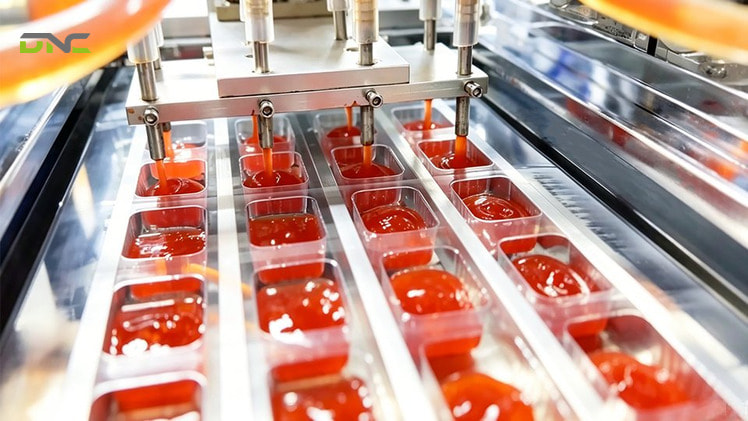
From a metrology point of view, a displacement filler dispenses the same swept volume on every stroke, and entrained air decides how much mass that volume carries. The relation is fixed and unremarkable: weight equals volume multiplied by bulk density. Nothing inside a piston barrel, a gear set, a peristaltic tube or a progressive cavity monitors the density term. The machine is accurate about volume by construction and silent about mass by design.
Viscous product is exactly the material that destabilises the density term. Jinlu Packing documents the mechanism without drawing the conclusion: “highly viscous liquids tend to trap air easily, especially during the initial viscous paste mixing stage,” and when the filler draws product too quickly, “air bubbles stay inside for a long time instead of disappearing quickly.” Thin liquid releases entrained air on its own; thick liquid holds it. One supplier’s engineering guide observes the same behaviour upstream, warning that inadequate hopper agitation at higher speeds causes de-aeration, settling or phase separation. IDA Equipment reaches for vacuum filling and diving nozzles specifically to keep air out of the container.
Three suppliers therefore describe air entrainment, and all three stop at unstable volume or at product appearance. None of them converts it into the quantity printed on the label. The magnitude available is routinely underestimated — aeration taken to its limit turns 250 mL of liquid cream into roughly 1,000 mL of whipped cream while the mass stays at 250 g (8.82 oz / 0.25 kg), per Motan Group. A production line never reaches that extreme. It does not need to, because the tolerance it is working against is a fraction of one percent.
A published sizing example from Fuluke shows how quietly the assumption enters an engineering calculation. Filling 50 g (1.76 oz / 0.05 kg) at 40 containers per minute gives 2,000 g per minute, or 120 kg per hour (264 pounds / 120000 grams). Converting that mass rate into a pump displacement requires a density, and the worked example states it as a fixed 1.02 g/mL, producing about 1,961 mL per minute and a piston stroke of roughly 49 mL per cycle (1.66 fl oz / 0.049 litres). The arithmetic is correct. The fixed density is the part that a viscous, air-entraining product does not honour batch to batch.
The consequence runs in a chain that ends on the profit line rather than the datasheet.
- Viscosity rises, and the product retains the air worked into it during mixing and transfer.
- Bulk density falls, by an amount that varies with batch, with agitation and with holding time.
- The volumetric dose delivers variable mass, while the filler reports every cycle as identical.
- The plant raises the setpointto protect the minimum declared weight, since a volumetric system cannot self-correct for density drift.
- Giveaway is paid on every packfor the operating life of the line.
Two pieces of hardware break that chain, and both sit inside a weighing specification rather than a filling one. Weighing each dose at the head with a load cell removes the density term from the control loop entirely. Weighing every finished pack downstream on a checkweigher leaves the density term in place and catches its consequences, which is the cheaper retrofit and the slower feedback. Choosing between them is a genuine engineering decision. Choosing neither, on a viscous product sold by weight, is a decision to pay giveaway indefinitely.
Entrained Air Is What Turns a Correct Volume Into an Incorrect Weight
Summary: What the Product Has Already Decided
The product has already decided three things about the filler shortlist by this point, and no catalogue produced any of the three cuts. A resolved viscosity statement carrying shear rate and temperature removed gravity and overflow filling from contention above roughly 1,000 centipoise. Sorting the survivors by controlled quantity separated four volume-metering families from one mass-metering family, and showed that their published accuracy percentages describe different physical quantities. Recognising that viscous product holds entrained air identified bulk density as the term that decides whether a correct volume becomes a correct weight. What remains is the question of how an accuracy claim on the mass side can be checked at all.
OIML R 61-1:2017 Gives the Mass-Measuring Family a Class a Quotation Can Name
In terms of verification, a net-weight filler belongs to the one family OIML R 61-1:2017 covers, and the recommendation gives that family an accuracy class that a quotation states. OIML R 61-1:2017 covers automatic gravimetric filling instruments, defined in its scope as instruments “intended to fill containers with a predetermined and virtually constant mass of product from bulk (including liquid material) by automatic weighing.” The parenthesis is doing real work — the recommendation is frequently assumed to be a powder document, and it is not.
The recommendation names the parts a quotation should itemise: a load receptor, a feeding device, and a control device comprising a feed control device, a fill setting device, a final feed cut-off device and a correction device. That last item is what allows a weighed filler to compensate for the product still in flight when the valve closes — the same tail that Palamatic Process describes in the three-phase feed cycle of high-speed feed, low-speed feed at about ten percent of the high rate, and fall tail.
Accuracy under R 61-1 is expressed as a class rather than a percentage. An instrument carries a designation X(x), where the maximum permissible deviation for that class equals the Table 2 value multiplied by x, and x is at most 2 in the form 1, 2 or 5 times a power of ten. Table 2 itself is a staircase across nine fill bands for class X(1), running from 7.2% of the fill for doses up to 50 g down to 0.8% above 15 kg, with in-service limits set 1.25 times looser than the initial verification limits. A separate table fixes Minfill, the minimum fill below which the class no longer applies at all.
Three properties follow from that structure, and none of them is available from a brochure percentage.
- The percentage is tied to a fill size.A ±0.5% claim with no fill band attached cannot be checked, because the permitted deviation legitimately changes by an order of magnitude across the range.
- The percentage has a floor.Below Minfill there is no valid class, which matters for sachet and small-jar formats at the bottom of a viscous-product range.
- The percentage has two values.Initial verification and in-service operation are different limits, so an instrument passing on installation day is being held to a different number in year three.
For a Malaysian exporter, the practical distinction is between two OIML documents that the market treats as one. IDA Equipment cites R87, which governs the net quantity declared on a finished prepackage and the sampling plans a market-surveillance authority applies to it. R 61-1 governs the instrument that produced the fill. A plant can satisfy R87 by overfilling with an unclassified volumetric machine and paying for it, or by specifying an instrument whose class makes the outcome predictable. The same logic already applies to a batching and dosing weighing system upstream of the filling line, where the mass of each ingredient is set before the product ever reaches a nozzle.
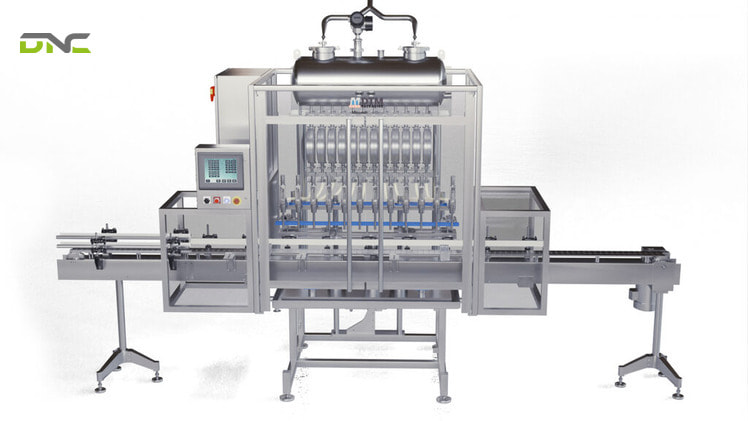
OIML R 61-1:2017 covers automatic gravimetric filling instruments
Nozzle Cut-Off and Product Temperature Decide Whether the Chosen Family Performs
A correctly chosen filler still strings, dribbles and blocks when cut-off and temperature are left to the installer. Four of the five suppliers on this results page raise nozzle behaviour as a distinct failure mode from metering, which puts it among the better-covered aspects of the topic — and it stays a commissioning problem rather than a selection problem.
The most specific published mechanics come from Fuluke. Anti-drip nozzles carry a built-in shut-off needle or a pinch-valve arrangement; tapered low-flow orifices with lip geometry reduce capillary stringing; and servo-controlled piston fillers perform a micro-retraction of 0.5–1.5 mm immediately before cut-off to relieve residual pressure in the line. Dip filling, where the nozzle enters the container and withdraws as the level rises, suppresses both air entrainment and stringing at the cost of a harder sanitation case. Apex Filling Systems arrives at the same place with wider nozzles and pressurised dispensing for dense product.
Temperature control belongs to the same commissioning conversation because it moves the target rather than the tool. Warming product 2–8 °C above batch temperature reduces viscosity and stringing without reformulating, per that same guidance, and jacketed hoppers with PID control keep the product inside a narrow band across a shift. Jinlu Packing frames the same measure as pump relief: heating lowers the load on the pump and raises the speed the line can hold. Pressure is the reason to care. Thicker product raises pipeline pressure, and Jinlu Packing traces that rise through damaged seals and overloaded motors to a stopped line, while the same source recommends sizing motors with a 1.5–2× safety factor against nominal power to absorb startup and thicker-than-nominal batches.
Product hardening during a stoppage is the failure that catches lines with frequent changeovers. Jinlu Packing notes that viscous product exposed to air in a paused nozzle dries and blocks the line, which turns every unplanned stop into a cleaning event rather than a restart.
Particulates, Shear Sensitivity and Corrosivity Outrank the Viscosity Answer
Three product properties overrule the filler chosen on viscosity alone: solid inclusions, shear-sensitive structure and corrosivity. Each one removes families from the shortlist that the viscosity figure had left in it, and all three are cheaper to raise at enquiry stage than at commissioning.
Particulates set a minimum clear path. Packserv reports that product carrying fruit pieces, seeds or fibres needs accessories designed to move particulates without damaging them. One supplier’s decision matrix separates the families on this axis directly — progressive cavity pumps pass soft particulates, gear pumps struggle with large ones — and IDA Equipment adds lobe pumps as the gentle high-volume option for viscous product with inclusions. A piston head handles small inclusions and shears larger ones against the valve seat.
Shear sensitivity protects product structure rather than fill accuracy. Emulsions, gels and suspended actives lose the structure that gives them their texture when pumped hard, and low-shear families are recommended for exactly this reason, singling out peristaltic and progressive cavity heads. IDA Equipment reaches the same recommendation for shear-sensitive actives in serum formulations.
Corrosivity decides what the product touches. Peristaltic heads isolate the mechanism behind disposable tubing so the product contacts nothing else, which is why IDA Equipment recommends them for corrosive chemistry despite their viscosity ceiling. Where corrosive product is also thick, the two constraints collide and the answer moves to material specification instead — 316L wetted parts with PTFE or FKM seals, as both IDA Equipment and the Fuluke guidance specify. Drum-scale corrosive filling carries the same constraint at a different volume, which is why an automatic drum filling station is specified on wetted materials before it is specified on rate.
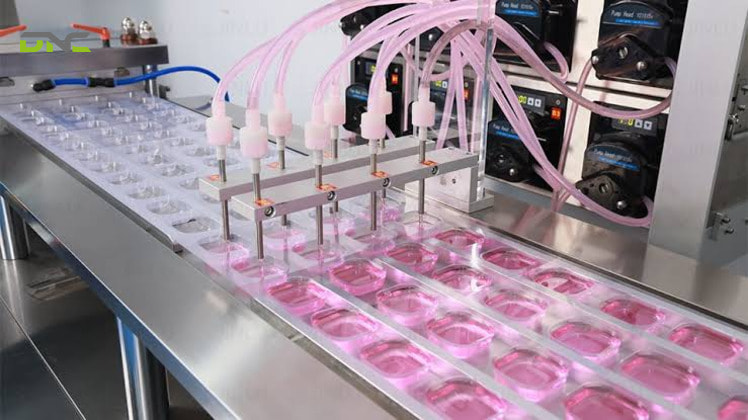
Particulates, Shear Sensitivity and Corrosivity Outrank the Viscosity Answer
Cleaning Design Is Specified Before the Machine Is Built, Not After
Cleaning cost on a viscous-product filler is specified at the drawing stage, before the machine is built, through material, surface finish and geometry. Three suppliers converge on the same specification, which makes it one of the firmer consensus points on this topic. Fuluke lists AISI 316L product-contact parts, tri-clamp connections, drainable geometries and polished surfaces at Ra ≤ 0.8 µm; IDA Equipment specifies 316L with an electropolished finish at the same roughness, PTFE or FKM seals and enclosed drains; Jinlu Packing frames the requirement from the failure side, noting that sticky residue clings to pipes, pumps, valves and nozzles.
Removable wetted parts are the hedge worth buying. The same source recommends specifying removable cylinders, nozzles and wear components so that manual cleaning stays viable when clean-in-place proves ineffective on an oil-rich formulation.
The clean-in-place sequence published by that supplier runs in four ordered stages.
- Warm water pre-rinseto displace bulk product before any detergent contacts the residue.
- Alkaline washcirculated at temperature, with surfactant or caustic chemistry chosen by the detergent supplier.
- Heated rinseto clear the wash chemistry from every wetted surface.
- Acid passivationwhere the material and the product history call for it, with a solvent-compatible or enzymatic step added for oil-rich product.
Validation closes the loop through visual inspection, total organic carbon measurement, ATP swabs and microbiological testing, against acceptance criteria documented in advance. ISO 22716 supplies the governing framework for cosmetics, and cGMP expectations apply on pharmaceutical and nutraceutical lines.
Summary: What Still Has to Be Proven on the Floor
The filler specification is complete on paper at this stage, and what still has to be proven on the production floor is every assumption inside it. A resolved viscosity statement, a controlled-quantity decision, a verification method for the mass side, a nozzle and thermal package, an override check against particulates and shear, and a cleaning design together describe a machine precisely enough to quote. Not one of those decisions has yet met the actual product. Every supplier consulted for this article says the same thing about that gap, and the way how a checkweigher works on the line downstream depends on the same evidence, since a weighing window can only be set once the real fill distribution is known.
A Fill Test With Real Product Settles What the Datasheet Cannot
The candidate filler earns its specification on a fill test with real product, not on a datasheet. Packserv states the position directly: a product fill test “is one of the most effective ways to determine the best filling solution,” evaluating accuracy, production speed, product handling, changeover requirements and cleaning procedures before any equipment is installed. One supplier’s engineering guide reaches the same conclusion, holding that calculated pump and motor figures “are guidelines, not substitutes for test runs.”
A fill test for viscous product answers questions no calculation reaches.
- Measured fill distribution, in mass rather than volume, across enough cycles to see batch-to-batch density drift rather than cycle-to-cycle repeatability.
- Behaviour at production shear, since the published scale-up guidance separates pilot rates of 10–30 containers per minute from production rates of 60–120 and warns that feed, thermal and quality-control limits appear only in the gap.
- Thermal drift under running load, because pumps and high-speed metering heat the product and change the rheology the specification assumed.
- Cleaning time at production soil, measured after an endurance run rather than after a short demonstration.
- Verification throughput, since fill checking has to match line speed or rejects accumulate faster than inspection clears them.
An endurance run of several hours at target rate is the recommended form, with yield, torque and temperature trends recorded and the cleaning cycle validated at production pace. When our engineers quote a viscous-product line, the flow curve and the fill-test result are the two documents requested before a machine model is named, and the weighing system integration scope is written against the fill distribution that test produces rather than against a nominal accuracy figure.
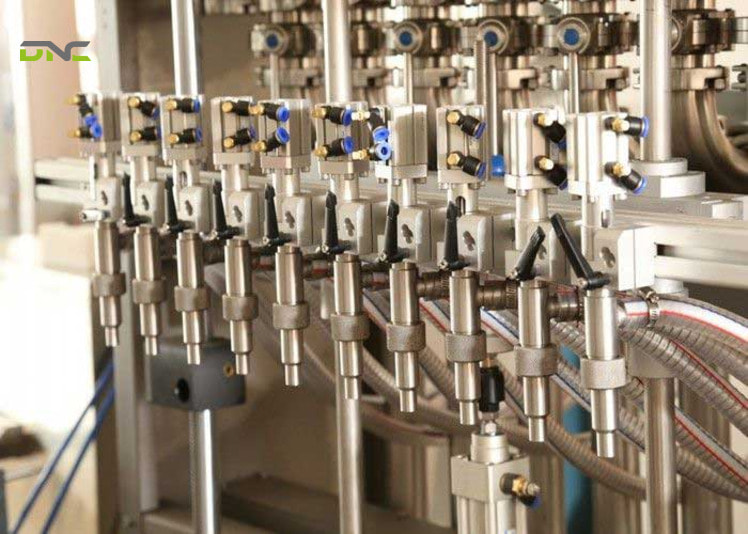
A Fill Test With Real Product Settles What the Datasheet Cannot
Frequently Asked Questions About Choosing a Filler for Viscous Products
Six questions recur across viscous-product filler enquiries reaching our engineering team, answered here against the sources listed at the end of this article.
What viscosity is too high for a piston filler?
No single ceiling applies, because the published limits are quoted without the shear rate and temperature that produced them. IDA Equipment publishes a piston range of 1,000–100,000+ cP, and the Fuluke guidance moves to progressive cavity pumps for product reaching hundreds of thousands of mPa·s. Product that shear-thins substantially may sit inside the piston range at production shear while reading far above it on a bench.
Is a piston filler more accurate than a net-weight filler?
The two accuracy figures describe different quantities, so they do not rank against each other. IDA Equipment publishes about 0.5% for piston filling and ±0.1–0.2% for net-weight filling, and the first percentage applies to dispensed volume while the second applies to delivered mass. On a product with stable density the two converge; on an air-entraining viscous product they diverge, and only the mass figure describes what the pack declares.
Does a viscous product need a checkweigher?
A checkweigher is needed wherever the pack declares a quantity the filling head does not measure. Every volume-metering family — piston, gear, peristaltic, progressive cavity — controls volume rather than mass, which leaves net-content compliance to be verified downstream. A net-weight head measures mass at the point of fill and moves that burden forward rather than eliminating it.
Why does the same recipe fill differently between batches?
Bulk density drift is the usual cause on viscous product, and entrained air is the usual cause of the drift. Air worked into thick product during mixing and transfer does not escape the way it does from thin liquid, so a constant dispensed volume carries a variable mass. Motan Group and SHK Pack both report that volumetric systems cannot self-adjust for density fluctuation, which is why deliberate overfill is the standard compensation.
Can one filler run both thin and thick products?
A single machine covers a wide viscosity range when the metering family is chosen for the thick end and the nozzle package for the thin end. Piston and progressive cavity heads reach down the range more comfortably than gravity or overflow heads reach up it. Changeover cost rises with the spread, since the same source reports that per-SKU parts, cleaning validation and recipe parameters all multiply across a wide portfolio.
Where does OIML R 61-1 apply and where does R87 apply?
R 61-1:2017 applies to the automatic gravimetric filling instrument, and R87 applies to the net quantity declared on the finished prepackage. The first sets an accuracy class, a maximum permissible deviation staircase and a minimum fill for the machine; the second sets sampling plans and permitted errors for market-surveillance checks on the pack. A plant can meet R87 through giveaway on an unclassified machine, or through an instrument whose class is stated.
Talk to Our Engineers About Your Viscous-Product Line
Your filler specification reduces to three decisions, and our engineers work them in that order: which quantity the pack has to be right about, whether the product’s entrained air puts that quantity at risk, and where the verification sits once the metering family is fixed. DNC Automation engineers, supplies and commissions filling machines alongside conveyors, load cells, weighing indicators, checkweighers, carton sealing and robotic palletizing as one end-of-line sequence, backed by 35 engineers, a production floor of 25,000 sq ft (2323 sqm / 0.23 hectare) and ISO 9001:2015 certification across 20 years of Malaysian manufacturing work. Automation investment under NIMP 2030 rewards lines that can evidence their own accuracy, which puts the measurand question on the funding path as well as the engineering one.
If your line fills sauces, edible oils, creams, latex compounds or treatment chemicals, bring us the flow curve, the container and the rate. The filling family, the verification point and the giveaway margin follow from those three inputs — talk to our engineers before the machine is chosen.
- 13 views
- 0 Comment
Recent Comments