


Conveyor Wheels: Skatewheel vs Roller Types, Load Ratings, and Selection Guide
Conveyor Wheels: Skatewheel vs Roller Types, Load Ratings, and Selection Guide
Conveyor wheels are the rolling elements that support and transport products along conveyor frames — either as individual skate wheels (small disc wheels on axles) in skatewheel conveyors, or as full-width cylinder rollers spanning the conveyor frame in roller conveyors. The choice between skatewheel and roller configurations — and between different wheel materials — determines what products can be conveyed, how much load is supported, and what surface contact is acceptable.
In Malaysian warehouses, distribution centres, and factories, gravity conveyors using wheels and rollers serve as the economical complement to powered belt and chain conveyors — providing low-cost, unpowered product flow on inclined sections, truck loading/unloading operations, and temporary or seasonal conveyor configurations.
Conveyor Wheel Types
Skate Wheels (Skatewheel Conveyor)
Skate wheels are small disc-shaped wheels (typically 50–90 mm diameter, 6–15 mm wide) mounted in pairs on transverse axles across the conveyor frame. Multiple rows of skatewheels form a conveying surface — product rests on multiple wheels across and along its bottom surface.
How gravity works: Product weight creates a normal force on the inclined skatewheel surface. The wheel’s minimal rolling resistance (ball-bearing mounted discs) allows product to roll forward on very gentle slopes — minimum 2–3° for light cartons (0.5 kg); 4–6° for heavier products (5–10 kg).
Wheel materials:
- Zinc-plated steel: Maximum durability, standard for warehouse use. Load per wheel: 15–30 kg.
- High-density polymer (HDPE/nylon): Lighter, quieter, lower cost. Load per wheel: 8–20 kg.
- Polymer with steel ball bearings: Best combination of low rolling resistance and quiet operation.
Applications:
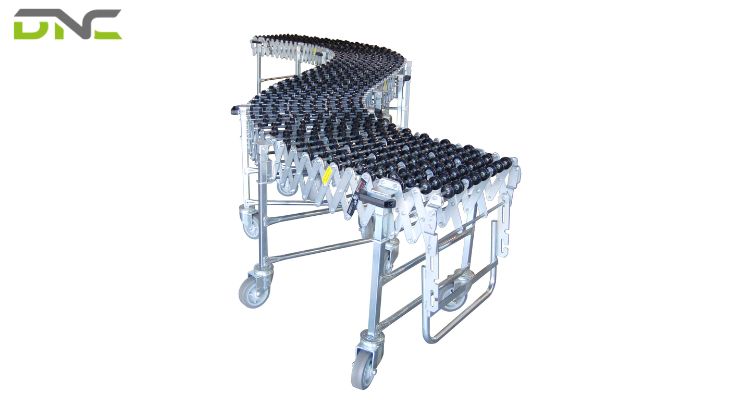
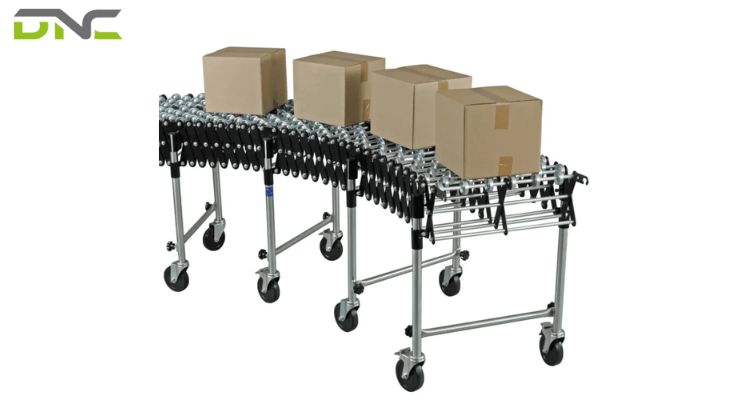
- Truck loading/unloading (expandable skatewheel conveyors)
- Carton sorter merge/divert surfaces
- Gravity flow rack — product slides forward in storage pallet racking
- Retail goods-in conveyor (temporary use)
Limitations:
- Requires flat, rigid product base — cartons, plastic totes, boxes only
- Soft-bottom packages (bags, pouches, flexible packaging) sag between wheels and jam
- Minimum product span: product must contact at least 4 wheels simultaneously — minimum product length = 2× wheel row spacing
- Not suitable for oily, wet, or food-contact environments (steel wheels corrode; polymer wheels absorb grease)
Full Roller (Gravity Roller Conveyor)
A full roller spans the full width between conveyor side frames — a steel, PVC-coated, or aluminium tube rotating on a fixed axle. Multiple rollers spaced along the frame length create the conveying surface.
Roller diameters (determines load and product stability):
| Roller Diameter | Max Load/Roller | Typical Use |
| 25 mm (1″) | 5–10 kg | Very light parcels, bags |
| 35 mm (1.4″) | 10–20 kg | Light cartons (<5 kg/item) |
| 50 mm (1.9″) | 20–50 kg | Standard cartons (5–25 kg) |
| 60 mm (2.37″) | 40–80 kg | Medium-heavy cartons |
| 75 mm (3″) | 80–150 kg | Heavy totes, pallets, machinery |
| 89 mm (3.5″) | 150–300 kg | Heavy industrial |
Roller spacing: Product must be supported by at least 3 rollers simultaneously. Minimum product length = 3 × roller spacing + safety margin.
Gravity slope: 1.5–3° for light products on well-maintained rollers; 3–5° for general cartons; 5–7° for heavy products.
Roller materials and coatings:
- Steel tube, zinc-plated: Standard gravity conveyor. Corrodes in wet environments.
- PVC-covered steel: Product-friendly soft contact; reduces product noise and marking. Food-adjacent applications.
- Stainless steel SS304: Food, pharma, chemical environments.
- Aluminium: Lightweight, non-magnetic, corrosion resistant. Electronics, food, and cleanroom.
- UHMWPE covered: Maximum product protection, silent, food-grade.
Skatewheel vs. Roller Conveyor: Selection Guide
| Parameter | Skatewheel | Full Roller |
| Product requirement | Flat, rigid base (carton, tote) | Flat base preferred; flexible products possible with close roller spacing |
| Minimum product span | 4 wheels (2 rows) | 3 rollers |
| Maximum load | 50–150 kg total (conveyor-dependent) | 500+ kg (heavy-duty rollers) |
| Rolling resistance | Very low (point contact) | Low (line contact — slightly higher) |
| Gravity slope needed | 2–4° | 1.5–3° |
| Product contact | Minimal (small wheel contact points) | Full-width roller contact |
| Soft/flexible products | Not suitable | Suitable with close-spaced small rollers |
| Wet/food environment | Not suitable (open bearings) | Suitable with stainless and sealed bearings |
| Cost | Lower | Higher |
| Noise | Moderate | Moderate to high (steel roller) |
Choose skatewheel when: Product is rigid flat-base cartons or totes, maximum lightness and low cost required, temporary installation (gravity flow racks, truck loading).
Choose full roller when: Products may be flexible, heavier loads (>15 kg per item), food or wet environment, powered roller conveyor (MDR).
Powered Roller Conveyor Wheels
In powered roller conveyors (MDR systems and line-shaft driven), rollers become motorised components rather than passive gravity elements:
MDR (Motor Driven Roller): 24VDC or 48VDC brushless motor sealed inside the roller tube. The motor body fixes to the frame (stator); the roller tube rotates (rotor). Product rests directly on the powered roller tube. See the Motorised Roller Conveyor guide for full MDR specifications.
O-ring driven passive rollers: Passive rollers adjacent to the MDR drive roller are connected by O-rings (rubber bands) running in grooves on the roller ends. The MDR turns → O-ring transmits torque → adjacent passive roller turns. Zone width = MDR roller + 3–6 passive rollers connected by O-rings.
What Are Conveyor Wheels
Conveyor Wheel and Roller Bearing Types
The bearing inside the conveyor wheel or roller shaft determines rolling resistance, load capacity, and maintenance requirement:
Ball bearing (deep groove): Standard for all conveyor rollers and most skate wheels. Low rolling resistance; suitable for medium to high speeds; sealed (2RS) versions are maintenance-free.
Roller bearing (cylindrical): Higher radial load capacity than ball bearings — used in heavy-duty gravity rollers (>100 kg/roller) and powered roller applications.
Nylon bushing: Simple, inexpensive, low rolling resistance for light loads — common in low-cost skate wheels and lightweight gravity rollers. Not suitable for high loads or high speeds.
Sealed vs. open bearings: Sealed bearings (2RS) are the standard for food, wet, and dusty environments — rubber seals prevent contamination ingress and retain grease for maintenance-free operation (typically 20,000–50,000 hours rated life). Open bearings require periodic relubrication.
Load Calculation for Gravity Conveyor Wheels
Minimum slope for gravity roller conveyor:
For each conveyor section: θ (min) = arctan[(μ × m × g) / (m × g)] = arctan(μ)
Where μ = rolling resistance coefficient:
- Ball bearing roller, lubricated: 0.01–0.02
- Ball bearing roller, slightly contaminated: 0.03–0.05
- Skatewheel, clean: 0.02–0.04
For 1.9″ (50 mm) diameter ball-bearing roller with μ = 0.02: minimum slope = arctan(0.02) ≈ 1.1° (approximately 2%)
In practice: design gravity conveyors at 3–5° slope to account for product variation, bearing ageing, and product alignment — greater slope margin = more reliable gravity flow.
Maximum slope: Product must not accelerate excessively at steep slopes — products may arrive at destination too fast for safe accumulation. Maximum practical slope for cartons: 10–12°. Above this, braking or controlled flow (powered accumulation zones) is required.
Conveyor Wheel Applications in Malaysian Industry
3PL and Distribution (Klang Valley)
Gravity roller and skatewheel conveyors are standard equipment at Malaysian 3PL and distribution centres for:
- Goods-in receiving conveyors (extendable gravity roller for truck unloading)
- Manual sorting lines (product pushed between workstations on gravity rollers)
- Packing station outfeed (gravity roller to weighing conveyor)
Manufacturing Flow Racks
Kanban and lean manufacturing operations in automotive and electronics facilities use gravity flow racks — inclined pallet racking fitted with roller or skatewheel lanes where components feed forward to the assembly workstation as they are consumed.
Toyota’s Shah Alam plant and Tier-1 suppliers in Shah Alam and Subang use roller flow rack systems extensively for JIT component presentation at assembly stations.
Food Processing
Stainless steel roller conveyors (SS304, sealed bearings) serve as product accumulation tables between process stages — post-filling carton accumulation before sealing, post-label application carton accumulation before palletising. IP65-rated sealed rollers handle daily washdown.
Benefits of Using Conveyor Wheels in Automated Systems
Maintenance
Gravity roller and skatewheel conveyors have very low maintenance requirements:
Monthly: Rotate each roller by hand to confirm free rotation — seized rollers cause product to slide and scratch instead of roll. Replace seized rollers immediately.
Quarterly: Inspect roller surface for grooves, flat spots, or corrosion — all cause uneven product transport and potential tipping.
Annual: Replace all rollers in high-use sections (>2 shifts/day) approaching rated bearing life. Inspect frame and axle for corrosion.
Skatewheel conveyors: Inspect wheel rotation and axle condition monthly; replace individual wheels with seized bearings.
DNC Automation’s Conveyor Roller and Wheel Solutions
DNC Automation supplies and integrates gravity roller conveyors, skatewheel conveyors, and powered MDR roller conveyors for Malaysian manufacturers and distributors — from standard catalogue supply to custom-fabricated stainless steel systems.
Supply range: 1.4″, 1.9″, 2.37″, and 3″ diameter steel and stainless rollers; UHMWPE-coated rollers for food contact; sealed-bearing roller assemblies; expandable skatewheel sections; complete gravity roller conveyor frames in standard and custom lengths.
Contact DNC Automation for conveyor wheel and roller selection, frame sizing, and complete gravity conveyor system proposals.
Summary
Conveyor wheels — skatewheels and full rollers — are the simplest and most economical product transport elements for gravity flow material handling. Skatewheels serve light rigid-base products on gentle inclines; full rollers handle heavier and more varied products. Material selection (steel, PVC-coated, stainless, aluminium) determines the environment suitability; bearing type (sealed ball bearing vs. bushing) determines maintenance frequency and service life. For Malaysian warehouses and factories, gravity roller and skatewheel sections complement powered conveyor systems as economical manual flow lines, truck loading extensions, and component flow racks.
- 104 views
- 0 Comment
Recent Comments